Technical Portrait 026
Alexander Graham Bell
The visionary who studied the mechanics of silence and emerged with the blueprint to shrink the world.
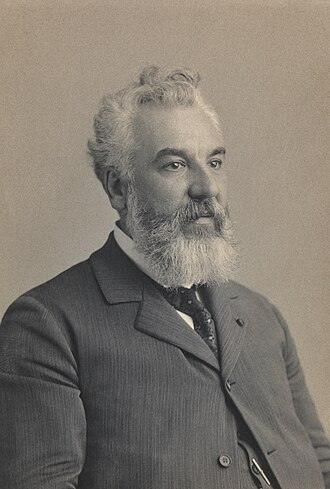
History often flattens polymaths into a single, defining achievement. For Alexander Graham Bell, that achievement is the telephone. Yet, to view him solely as the inventor of a communication device is to misunderstand the driving force of his life. Bell was fundamentally a student of sound and an educator of the deaf; his inventions were the magnificent byproducts of his desire to understand human communication. He was a man who spent his life deciphering the mechanics of silence, driven by an empathy that was as profound as his intellect.
Born on March 3, 1847, in Edinburgh, Scotland, Bell was the son of Alexander Melville Bell, a renowned elocutionist and creator of "Visible Speech," and Eliza Grace Symonds, an accomplished painter and musician who was nearly deaf. This environment—one of vocal precision and silent resilience—shaped his worldview from infancy. He was a curious child, inventing a de-husking machine for a local flour mill at just twelve years old. However, his early academic career was marked by an indifference to traditional schooling, as he preferred to pursue his own scientific interests, often wandering the hills of Scotland to study nature and sound.
In 1870, tragedy struck the Bell family as both of Alexander's brothers succumbed to tuberculosis. Fearing for Alexander’s health, the family immigrated to Brantford, Ontario, seeking the "invigorating" air of the Canadian countryside. It was in the quiet sanctuary of the Tutela Heights farm that Bell began formulating the theoretical concepts of transmitting speech over electrical wires. His work was deeply personal: both his mother and his future wife, Mabel Hubbard, were profoundly deaf, and his primary motivation was never commercial gain, but the restoration of connection for those isolated by silence.
The Invention of the Telephone
While his primary research was on "visible speech" and teaching deaf individuals to articulate, Bell became obsessed with the idea of a harmonic telegraph—a device capable of sending multiple messages over a single wire simultaneously. In the summer of 1874, while sitting by the Grand River at his father's home in Brantford, he had his "Eureka" moment. He realized that if he could vary the intensity of an electrical current in the same way that air varies in density during the production of sound, he could transmit the human voice. This was the birth of the telephone's conceptual framework, which he described as his "dreaming place."
Working in Boston with his skilled assistant, Thomas Watson, Bell faced numerous technical hurdles. They spent countless hours refining the "liquid transmitter" and the electromagnetic receiver. On March 10, 1876, the breakthrough occurred. After accidentally spilling acid on his clothes, Bell called out, "Mr. Watson, come here, I want to see you." Watson, listening at the other end of the wire in a separate room, heard the words clearly. It was the first successful transmission of intelligible speech. Shortly after, Bell returned to Ontario to conduct the world's first one-way long-distance call between Brantford and Paris, Ontario, on August 10, 1876, proving that the technology could bridge significant physical gaps.
However, Bell was a restless intellect who grew weary of the legal battles and corporate management required to sustain the burgeoning telephone industry. After co-founding the American Telephone and Telegraph Company (AT&T), he largely left the commercial enterprise behind. He sought a new laboratory where he could pursue his varied interests without the distractions of fame. This led him to the rugged beauty of Cape Breton, where he established a summer estate and research station he named Beinn Bhreagh—Gaelic for "Beautiful Mountain."
The Flight and the Hydrofoil
In Baddeck, Bell’s imagination took flight—literally. His fascination with aeronautics led him to experiment with tetrahedral kites, believing that their structural strength and lift could solve the problems of heavier-than-air flight. In 1907, he co-founded the Aerial Experiment Association (AEA) alongside talented young engineers like Glenn Curtiss and Douglas McCurdy. Their collaboration culminated in the construction of the Silver Dart. On February 23, 1909, McCurdy piloted the aircraft over the frozen Bras d'Or Lake, marking the first powered, heavier-than-air flight in the British Empire. This feat established Canada as a pioneer in the global aviation industry.
Not content with conquering the air, Bell turned his attention to the water. He was intrigued by the concept of hydrofoils—vessels that used wing-like structures to lift the hull out of the water, reducing drag and increasing speed. Working with Casey Baldwin, he developed the HD-4 hydrofoil. In 1919, the vessel reached a top speed of 114 km/h (70.86 mph) on the Bras d'Or Lake, setting a world marine speed record that would stand for two decades. These experiments were not merely about speed; they were about exploring the fluid dynamics of both air and water, a testament to Bell’s unified vision of physics.
Bell was a man who refused to respect the boundaries between scientific disciplines. His diverse portfolio of inventions included the photophone, a device that transmitted sound on a beam of light—a conceptual precursor to modern fiber optics. He also developed an early version of the metal detector in 1881, in a desperate attempt to locate a bullet lodged in U.S. President James A. Garfield after an assassination attempt. While the device was unsuccessful due to interference from the President's metal bedsprings, it showcased Bell's ability to apply his knowledge of electromagnetism to solve immediate, high-stakes problems. From medical devices like the "vacuum jacket" (an early iron lung) to sheep breeding experiments, Bell proved that a mind dedicated to understanding the fundamentals of nature can engineer miracles across any field.
The Legacy
Alexander Graham Bell’s impact on the modern world is so pervasive that it is often invisible. The global telecommunications network, which now transmits data at the speed of light, is the direct descendant of his research into sound and electricity. His co-founding of the National Geographic Society in 1888 helped institutionalize the exploration of the planet, while his role in launching the journal Science provided a platform for the most important scientific discoveries of the 20th century. Beyond his inventions, Bell’s dedication to the deaf community remained his most cherished work. He famously mentored Helen Keller, who dedicated her autobiography to him, writing that he "opened the doors of the world to me."
In Canada, Bell is remembered as a foundational figure in national science and identity. The Bell Homestead in Brantford and the Alexander Graham Bell National Historic Site in Baddeck serve as living monuments to his "dreaming places." His work with the Aerial Experiment Association not only produced the Silver Dart but also catalyzed the birth of the Canadian aerospace industry. On the day of his funeral in 1922, every telephone in North America was silenced for one minute—a silent tribute to the man who had spent his life ensuring that the world would never have to be silent again.
Notable Quotes
"When one door closes, another opens; but we so often look so long and so regretfully upon the closed door, that we do not see the ones which open for us."
— Alexander Graham Bell
"Concentrate all your thoughts upon the work at hand. The sun's rays do not burn until brought to a focus."
— Alexander Graham Bell
"Great discoveries and improvements invariably involve the cooperation of many minds."
— Alexander Graham Bell
"The day will come when the man at the telephone will be able to see the distant person to whom he is speaking."
— Alexander Graham Bell, predicting video calls in 1906
Operational Timeline
Origin
Born in Edinburgh, Scotland. Raised in a family dedicated to elocution and the science of sound.
The Move to Canada
Immigrates to Brantford, Ontario. The family farm at Tutela Heights becomes his first Canadian research base.
Conceptual Breakthrough
Formulates the theoretical principle of the telephone while sitting by the Grand River in Brantford.
The First Call
Successfully transmits human speech electronically in Boston; later conducts the first long-distance call in Ontario.
The Photophone
Invents the photophone, which transmits sound on a beam of light—the ancestor of modern fiber optics.
Induction Balance
Develops an early metal detector to assist in the medical treatment of President James A. Garfield.
Beinn Bhreagh
Purchases land in Baddeck, Nova Scotia, establishing a lifelong summer home and research laboratory.
National Geographic
Co-founds the National Geographic Society, later serving as its second president and transforming it into a global institution.
Aerial Experiments
Founding of the Aerial Experiment Association (AEA) to pursue the dream of heavier-than-air flight.
The Silver Dart
The AEA successfully flies the Silver Dart over the frozen Bras d'Or Lake, the first flight of its kind in Canada.
Marine Speed Record
The HD-4 hydrofoil sets a world marine speed record of 114 km/h on the waters of Nova Scotia.
Final Silence
Alexander Graham Bell passes away at Beinn Bhreagh. North America's phone systems fall silent in his honor.