Technical Portrait 045
Andre De Grasse
The sprinter who kept finding another gear when the lights were brightest.
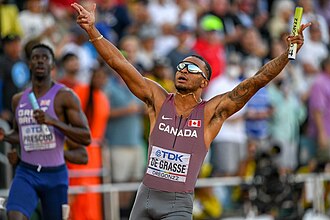
Andre De Grasse is a Canadian Super because his career made consistency look dramatic. Sprinting is a sport of tiny margins and sudden disappearances, yet De Grasse kept returning to the podium across multiple Olympic Games and distances. His 200-metre gold at Tokyo 2020, run in 2021, was the summit: a Canadian record, an Olympic title, and a race that rewarded years of controlled pressure.
He matters because Canadian sprinting after Donovan Bailey needed more than nostalgia. De Grasse supplied continuity. He showed that Canadian speed could survive into a different era, against different rivals, under a different global spotlight, with a style built less on loud dominance than on repeated championship execution.
The Canadian Identity
His Canadian identity begins in the Greater Toronto Area. Born in Scarborough and raised in Markham, De Grasse came to sprinting relatively late compared with many global stars. The familiar story is almost cinematic: a high-school basketball player running a race in borrowed-looking circumstances and revealing a gift that coaches could not ignore. The deeper Canadian story is about local systems noticing talent and helping it become durable.
De Grasse also represents the athlete produced by suburban Canada: school sport, club networks, family support, and the dense multicultural geography of the GTA. His calm public manner became part of his national appeal. He did not need theatrical intimidation to communicate seriousness.
The Achievement
The achievement is not only one gold medal. De Grasse became one of Canada's most decorated Olympic track athletes, winning medals in the 100 metres, 200 metres, and 4x100-metre relay. He built a career around championship execution: rounds, recovery, tactics, and the nerve to stay composed when the best sprinters in the world were lined up beside him.
His 200-metre gold was especially important because it demanded more than raw acceleration. The event rewards bend running, rhythm, distribution of effort, and the courage to keep pressing when lactic acid arrives. De Grasse's Canadian record in that race was the performance of an athlete who had learned how to turn repeated near-misses into command.
The Legacy
His legacy is a bridge between generations. Donovan Bailey made Canada the fastest country in the world for one unforgettable Olympic moment; De Grasse made Canadian sprinting feel repeatable in the modern era. He gave young athletes a contemporary model of speed with humility, technical growth, and competitive patience.
For Canadian track, De Grasse normalized the sight of the maple leaf in sprint finals. That is a major cultural achievement. Once a country sees its athletes medal repeatedly in the glamour events, the expectation changes. De Grasse helped make that expectation reasonable.
Operational Timeline
Born in Scarborough
Born in Scarborough, Ontario, and later raised in Markham within the sports culture of the Greater Toronto Area.
Draws attention as a late-emerging high-school sprint talent
Draws attention as a late-emerging high-school sprint talent, turning an informal-looking race into the beginning of an elite track career.
Wins NCAA titles and world championship medals
Wins NCAA titles and world championship medals, proving that his rise could translate into international results.
Wins three Olympic medals in Rio de Janeiro
Wins three Olympic medals in Rio de Janeiro, becoming one of the faces of a renewed Canadian sprint program.
Wins Olympic 200-metre gold in Tokyo with a Canadian record
Wins Olympic 200-metre gold in Tokyo with a Canadian record, converting years of podium finishes into an individual Olympic title.
Helps Canada win Olympic bronze in the 4x100-metre relay
Helps Canada win Olympic bronze in the 4x100-metre relay, extending his impact from individual events to the national relay system.
Remains one of Canada's leading sprint figures entering another Olympic cycle
Remains one of Canada's leading sprint figures entering another Olympic cycle, with his career already secure in national track history.