Arts & Activism 013
Buffy Sainte-Marie
The Voice of the Plains. A creative force whose music, digital art, and activism dismantled stereotypes and centered Indigenous life in the global conversation for over six decades.
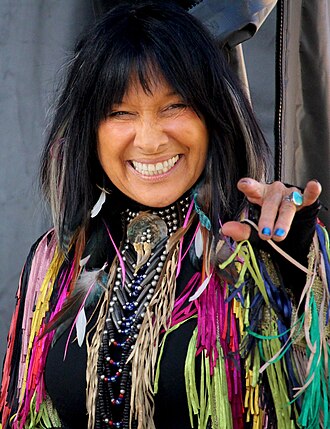
Buffy Sainte-Marie didn't just write songs; she wrote manifestos. Rising through the Greenwich Village folk scene in the early 1960s, she used her "primary power" of truth-telling to confront the erasure of Indigenous history and the persistent systemic injustices facing Native communities. Her vibrato, fierce and haunting, carried the weight of "Universal Soldier" and the defiant pride of "It's My Way" into the hearts of a generation. She was not merely a singer-songwriter but a social architect, using the stage as a pulpit and the recording studio as a laboratory for cultural transformation. Her presence in the folk revival was a radical act of reclamation, asserting an Indigenous identity that was simultaneously ancient and avant-garde.
Beyond the acoustic guitar, she was a technological pioneer who saw the potential of the digital age long before her contemporaries. In the early 1980s, she began using an Apple II to create digital art and was one of the first musicians to use the internet to distribute files and collaborate across distances. This "Super" ability to adapt and master new tools allowed her to reach students and communities directly through her Cradleboard Teaching Project, which provided Indigenous-centered educational curricula to schools across the continent. Her foresight in merging technology with traditional knowledge proved that being "modern" and "Indigenous" were not mutually exclusive, but rather complementary facets of a resilient, evolving culture.
The Early Years
For decades, the story of Buffy Sainte-Marie was told as one of a child taken from her home on the Piapot Cree First Nation in Saskatchewan and adopted into a white family in Massachusetts. This narrative of the "Sixties Scoop" shaped much of her public identity and the reception of her work. However, in late 2023, a CBC investigation presented evidence, including a birth certificate, indicating she was born Beverly Jean Santamaria on February 20, 1941, in Stoneham, Massachusetts, to parents of Italian and English descent. While this revelation has sparked intense debate and pain within Indigenous communities, the impact of her work and her decades-long relationship with the Piapot family, who formally adopted her according to Cree tradition in the 1960s, remains a central, albeit complex, part of her biography.
Regardless of the biological circumstances of her birth, Sainte-Marie was raised in New England, primarily in Maine, where she began to develop her artistic voice. She was a self-taught musician, learning to play the piano by ear as a young child and later picking up the guitar. Her early years were marked by a sense of being an outsider, a feeling that she channeled into her songwriting. She attended the University of Massachusetts Amherst, where she studied philosophy and Oriental philosophy, graduating in the top ten of her class. It was during these college years that she began performing in local coffeehouses, honing the unique vocal style and provocative lyrical themes that would soon make her a star in New York City.
The 1960s were a period of intense personal and political awakening for Sainte-Marie. She moved to Greenwich Village, the epicenter of the American folk music revival, and quickly established herself as a formidable talent. Unlike many of her peers who focused on traditional ballads or gentle protest songs, Buffy’s music was visceral and often confrontational. She sang about the "Universal Soldier," a song that became an anthem for the anti-war movement, and she spoke openly about the historical and ongoing mistreatment of Indigenous peoples in songs like "Now That the Buffalo's Gone." Her arrival on the scene was timely, as the United States was grappling with the Civil Rights Movement and the escalating conflict in Vietnam, providing a fertile ground for her message of social justice and systemic change.
The Work & Achievements
Sainte-Marie’s career is a masterclass in artistic evolution and social impact. In 1964, Billboard Magazine named her Best New Artist, and her debut album, It’s My Way!, is now considered a landmark in folk music. Over the next several decades, she released over 20 albums, each one pushing the boundaries of genre and technology. Her 1969 album Illuminations was a radical departure from her folk roots, featuring experimental electronic sounds created with a Buchla synthesizer. This pioneering work predated the widespread use of synthesizers in popular music by years, cementing her reputation as a "technological super" who was always several steps ahead of the curve.
In the mid-1970s, Buffy took her message to a new audience: the children of Sesame Street. As a semi-regular cast member from 1976 to 1981, she provided a generation with their first positive representation of Indigenous life. She didn't just appear on the show; she actively shaped its content. She famously breastfed her son on air, an act that was groundbreaking for the time and helped to normalize a natural process that was often stigmatized. She used the platform to explain Indigenous traditions, music, and contemporary life, ensuring that Indigenous presence was seen as a living, breathing part of the modern world. This work on Sesame Street remains one of her most significant contributions to cultural literacy and the dismantling of stereotypes.
The 1980s brought even greater mainstream recognition. In 1983, she co-wrote "Up Where We Belong" for the film An Officer and a Gentleman. The song, performed by Joe Cocker and Jennifer Warnes, became a massive global hit and earned Sainte-Marie an Academy Award, a Golden Globe, and a BAFTA for Best Original Song. At the time, she was celebrated as the first Indigenous person to win an Oscar. This achievement solidified her status as a cultural icon, though she continued to face challenges. Her outspoken activism, particularly during the Lyndon Johnson and Nixon administrations, led to her being blacklisted by American radio stations, a move that significantly hampered her commercial success in the U.S. but never silenced her voice.
The Cradleboard Legacy
Sainte-Marie's most lasting impact might be her role as a cultural translator and educator. In the late 1990s, she founded the Cradleboard Teaching Project through her Nihewan Foundation for Native American Education. Cradleboard was a visionary initiative that sought to transform the way Indigenous history and culture were taught in schools. By using early internet technology to connect Indigenous and non-Indigenous students, she created a digital bridge for cross-cultural understanding. The project provided curricula written from an Indigenous perspective, covering subjects from science to social studies, and challenged the "Columbus-centric" narratives that had dominated North American education for centuries.
Her work with Cradleboard was an extension of her "Super" ability to see the potential in new tools. She recognized that the internet could be a powerful equalizer, allowing Indigenous communities to bypass traditional gatekeepers and tell their own stories to the world. "I was an 'Indian' on a mission," she said, "and missions don't always have a radio budget." This sentiment captured her relentless drive to use whatever means necessary to elevate the voices of the marginalized. Her legacy is found not just in her songs, but in the thousands of students who saw themselves reflected in their schoolbooks for the first time because of her efforts.
In the later stages of her career, Sainte-Marie continued to innovate and inspire. Her 2015 album, Power in the Blood, won the prestigious Polaris Music Prize, proving that her artistic relevance remained undiminished even after fifty years in the industry. She continued to perform and speak out on issues of environmental justice, Indigenous sovereignty, and the importance of creativity. While the 2023 revelations about her ancestry have created a complex and painful chapter in her story, the tangible work she did—the songs she wrote, the programs she founded, and the representation she provided—remains a documented part of history. Her influence on generations of artists, from folk singers to digital creators, ensures that her "vibrato of truth" will continue to resonate.
Notable Quotes
"The only reason I ever became a singer in the first place was because I had something to say."
— Buffy Sainte-Marie
"Stay calm and decolonize. It’s a matter of looking at what we’ve been taught and asking, 'Does this make sense? Is it true?'"
— Buffy Sainte-Marie
"Everybody's creative. We create our songs and our paintings, our families and our children. Every one of us is on the cutting edge of the future."
— Buffy Sainte-Marie
"I was an 'Indian' on a mission, and missions don't always have a radio budget. You do what you have to do to get the message across."
— Buffy Sainte-Marie
Operational Timeline
Origin
Born Beverly Jean Santamaria in Stoneham, Massachusetts. Raised in New England, developing an early passion for music and philosophy.
The Arrival
Releases debut album 'It’s My Way!'. Named Best New Artist by Billboard Magazine. The album features the anti-war anthem 'Universal Soldier'.
Electronic Pioneer
Releases 'Illuminations', a groundbreaking album using the Buchla synthesizer, one of the first electronic music albums in history.
Sesame Street
Begins a five-year stint on Sesame Street, bringing Indigenous representation to millions and breastfeeding her son on air.
The Oscar
Wins the Academy Award for Best Original Song for 'Up Where We Belong', co-written for the film 'An Officer and a Gentleman'.
Digital Return
Returns to recording with 'Coincidence and Likely Stories', using early internet technology to transmit files between studios.
Hall of Fame
Inducted into the Canadian Music Hall of Fame. Her career is celebrated for its artistic excellence and social impact.
Cradleboard
Launches the Cradleboard Teaching Project, using technology to connect Indigenous and non-Indigenous students and reform curricula.
Governor General’s Award
Receives the Governor General’s Performing Arts Award for Lifetime Artistic Achievement, Canada's highest honor in the performing arts.
Polaris Victory
Wins the Polaris Music Prize for the album 'Power in the Blood', beating out younger contemporary artists and solidifying her relevance.
Legacy Scrutiny
A CBC investigation challenges her long-standing claims of Indigenous ancestry, sparking a national debate on identity and legacy.
Order Rescinded
Her appointment to the Order of Canada and other honors are rescinded in response to the heritage controversy.
The Cultural Frontier
In 2026, the legacy of Buffy Sainte-Marie is being re-evaluated through a lens of "complex impact." While her claims of Indigeneity have been discredited by documentation, her influence on the arts and social justice remains undeniable. Curators and historians now study her work as a critical intersection of media technology and social activism, where the *impact* of the message is weighed alongside the *identity* of the messenger.
The Sainte-Marie Digital Archive, launched in 2025, provides researchers with access to her early experiments in digital art and computer-mediated communication. This archive highlights her role as a "Super" of the information age, showing how she used emerging tools to bypass systemic barriers and create a platform for Indigenous issues that did not exist before her arrival.