Technical Portrait 017
David Suzuki
The scientist who invited a nation into his living room, transforming complex ecology into an urgent, collective moral imperative and redefining the role of the public intellectual.
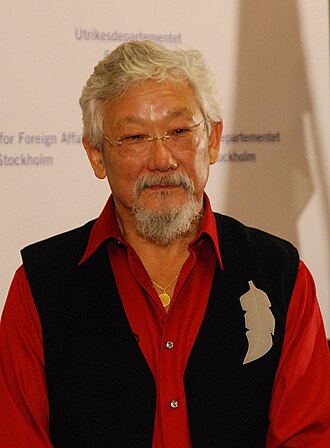
Long before climate change dominated global headlines, a geneticist with an unmistakable beard and an urgent cadence became the face of the Canadian wilderness. David Suzuki bridged the chasm between the ivory tower of academic science and the everyday consciousness of the public. He didn't just explain the natural world; he demonstrated unequivocally that humanity was an inextricable, vulnerable part of it. His "primary power" is his ability to translate the language of DNA and ecosystems into a compelling narrative of survival and responsibility, making him one of the most trusted voices in the country.
His early life was marked by profound injustice that forged a resilient and empathetic worldview. Born in Vancouver, Suzuki and his family were among the thousands of Japanese Canadians stripped of their rights and interned during World War II in camps in the British Columbia interior. Following the war, the family was forced to move to Ontario. It was during these years that Suzuki found solace and fascination in nature, a refuge that ultimately steered him toward a PhD in zoology and a lifelong commitment to defending the voiceless elements of our planet. This early experience of being treated as an "outsider" by his own government arguably sharpened his critical eye toward systemic failures in environmental policy.
The Early Life
David Takayoshi Suzuki was born on March 24, 1936, in Vancouver, British Columbia, to Setsu Nakamura and Carr Kaoru Suzuki. As a third-generation Japanese Canadian (Sansei), his early years were spent in a vibrant community that was abruptly shattered by the outbreak of World War II. In 1942, the Canadian government seized the family's dry-cleaning business and relocated them to an internment camp in Slocan, in the B.C. interior. For three years, Suzuki lived in a world defined by wooden shacks and the constant undercurrent of being a perceived enemy of the state. It was here, ironically, that his love for biology began. With few other forms of entertainment, he spent his days exploring the swamps and forests around the camp, collecting insects and observing the cycles of the local wildlife.
After the war, the Suzuki family was prohibited from returning to the West Coast and was forced to relocate to Ontario. They eventually settled in London, where David excelled in school, finding a sense of belonging in the pursuit of knowledge that had been denied to him by circumstance. He went on to attend Amherst College in Massachusetts, where he earned a B.A. in Biology in 1958, followed by a Ph.D. in Zoology from the University of Chicago in 1961. His academic focus was on genetics, a field that was then undergoing a revolution. He became an expert on the Drosophila melanogaster (the common fruit fly), using it as a model organism to study temperature-sensitive mutations. This rigorous scientific training provided the foundation for his later role as a communicator, giving him the credibility to speak on the complex biological systems that sustain life.
In 1963, Suzuki returned to Canada to join the genetics department at the University of British Columbia (UBC). He quickly established himself as a brilliant researcher and a charismatic teacher, winning the Steacie Memorial Fellowship in 1969 as the best young Canadian scientist. His "Super" ability in the lab was his precision and his capacity to see the broader implications of microscopic genetic changes. However, he soon realized that the most important work wasn't happening under a microscope; it was happening in the public square. He began to feel that scientists had a moral obligation to share their knowledge with the public, a belief that would eventually lead him away from the laboratory and toward the television studio.
The Work & Achievements
Suzuki’s transition from academic to broadcaster was a pivotal moment in Canadian media history. In 1970, he began hosting Suzuki on Science, followed by the groundbreaking radio program Quirks and Quarks in 1975. However, it was his appointment as the permanent host of CBC's The Nature of Things in 1979 that truly cemented his status as a national icon. The program was a revelation. It didn't just showcase stunning wildlife footage; it tackled hard, controversial issues: deforestation, the genetic modification of crops, the dangers of nuclear power, and the looming crisis of global warming. Through his calm, authoritative delivery, Suzuki made the invisible threads connecting ecosystems visible to the average viewer. He transformed science from a collection of facts into a living, breathing part of the Canadian identity.
He operated on the principle that people will only protect what they love, and they can only love what they understand. The Nature of Things became a staple of Canadian broadcasting, airing in over eighty nations worldwide and winning numerous international awards. Suzuki’s "Super" status as a communicator allowed him to challenge the status quo, often putting him at odds with powerful industrial and political interests. He wasn't afraid to call out the "myth of economic growth" or to highlight the devastating impact of resource extraction on Indigenous lands. His willingness to confront the powers that be earned him a reputation as a fearless advocate for the Earth, a scientist who refused to be silenced by the dictates of corporate or political expediency.
In 1990, recognizing that documentation alone was insufficient to stem the tide of ecological collapse, he co-founded the David Suzuki Foundation with his wife, Tara Cullis. The foundation became his primary tool for systemic change, focusing on science-based solutions to climate change, biodiversity loss, and environmental injustice. One of its most significant initiatives was the "Blue Dot" movement, which advocated for the legal recognition of the right to a healthy environment in the Canadian constitution. Through the foundation, Suzuki has influenced countless policies and inspired millions of individuals to take action in their own lives. He has authored over 50 books, including the seminal The Sacred Balance, which explores the profound interconnectedness of all life on Earth.
The Legacy of the Earth
David Suzuki’s legacy is best measured in the generational shift in environmental awareness he catalyzed. He has been honored with the Order of Canada (elevated to Companion in 2006), the Order of British Columbia, and the Right Livelihood Award, often called the "Alternative Nobel Prize." In 2004, he was voted the "Greatest Living Canadian" in a nationwide CBC poll, a testament to the deep respect and affection Canadians hold for him. He has shown that being a scientist is not just about observing the world, but about participating in it as a moral and ethical being. His work has laid the groundwork for the modern environmental movement in Canada and beyond.
In 2023, after 44 years at the helm, Suzuki retired as the host of The Nature of Things. His final episodes were a poignant reflection on his decades of work and a final, urgent call to action for the next generation. Even in retirement, he remains a vocal and active presence in the fight for climate justice. He often speaks about the "Sacred Balance"—the idea that we are biologically and spiritually connected to the air, water, soil, and sunlight. This philosophy is the true measure of his success: he has taught a nation that the Earth is not merely a resource to be extracted, but our only home, demanding our immediate and uncompromising defense. He has passed the torch to a new generation of "Super" advocates who carry his message forward into an uncertain but critical future.
In 2026, the David Suzuki Foundation remains a powerhouse of environmental strategy, its work more vital than ever as the world faces the escalating reality of the climate crisis. Suzuki’s presence is still felt in every classroom where kids learn about biodiversity and in every community that fights to protect its local watershed. He has turned "environmentalism" from a niche concern into a foundational Canadian value. As he often says, "In a world of seven billion people, where every one of us is trying to live a better life, we have to recognize that the planet is finite." His life has been a singular, powerful attempt to ensure that we recognize that limit before it's too late.
Notable Quotes
"We're in a giant car heading towards a brick wall and everyone's arguing over where they're going to sit. We need to focus on the wall."
— David Suzuki
"The way we see the world shapes the way we treat it. If we see species as biological kin rather than resources, we treat each other with greater respect."
— David Suzuki
"In a world of seven billion people, we have to recognize that the planet is finite. We are not outside of nature; we are nature."
— David Suzuki
"Reconciliation with the Earth is the most important task of the 21st century. Without a healthy planet, nothing else matters."
— David Suzuki
Operational Timeline
Origin
Born in Vancouver, BC. Spends early years in a thriving Japanese Canadian community before the outbreak of war.
Internment
Interned with his family in a camp in Slocan, BC. The experience of injustice and connection to nature shapes his future.
Academic Pinnacle
Earns a Ph.D. in Zoology from the University of Chicago, specializing in the genetics of fruit flies.
UBC Career
Joins the genetics department at the University of British Columbia, becoming a renowned researcher and teacher.
Broadcasting Debut
Starts hosting 'Suzuki on Science', his first foray into using television for scientific communication.
Quirks and Quarks
Becomes the founding host of the CBC Radio program 'Quirks and Quarks', bringing science to the national airwaves.
The Nature of Things
Takes the helm of 'The Nature of Things', a show that would redefine science broadcasting for the next four decades.
Kalinga Prize
Awarded the UNESCO Kalinga Prize for the Popularization of Science, recognizing his international impact.
Foundation Launch
Co-founds the David Suzuki Foundation to advocate for science-based solutions to environmental crises.
Greatest Canadian
Voted the "Greatest Living Canadian" in a nationwide CBC poll, reflecting his deep cultural resonance.
Companion of the Order
Elevated to a Companion of the Order of Canada, the highest level of the country's honors system.
Alternative Nobel
Receives the Right Livelihood Award for his outstanding contribution to environmental and social responsibility.
Final Episode
Retires as the host of 'The Nature of Things' after 44 years, passing the torch to a new generation of presenters.
Ongoing Advocacy
Continues to be a leading voice for climate justice and environmental rights through his foundation and public appearances.