Technical Portrait 044
Donovan Bailey
The sprinter who made the 100 metres a Canadian event for one incandescent Olympic night.
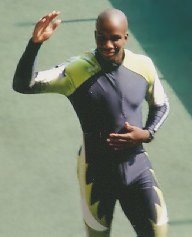
Donovan Bailey gave Canada one of its cleanest sporting moments: a straight line, a finish tape, and a world record. At the 1996 Olympic Games in Atlanta, Bailey won the 100 metres in 9.84 seconds, becoming Olympic champion and the fastest man in history at that moment. For a country more often associated with ice, distance, and endurance, the symbolism was electric. Canada had the fastest sprinter on Earth.
His importance is not only that he won. It is that he won the event that often carries the bluntest symbolic force in world sport. The 100 metres asks one question in the simplest possible form: who is fastest? Bailey answered it for Canada in a way that was impossible to soften or explain away.
The Canadian Identity
Bailey's Canadian identity is rooted in migration and adulthood. Born in Jamaica, he moved to Canada as a child and grew up in Oakville, Ontario. He did not follow the simple prodigy script. His rise into elite sprinting came later than most, after business work and a less conventional path into the sport. That makes the achievement feel especially Canadian: not inevitable, not polished from childhood, but built through timing, confidence, and a refusal to accept the expected hierarchy.
He also expanded the image of Canadian athletic identity. Bailey brought Caribbean speed culture, Ontario training, and unmistakable competitive self-belief into one national performance. His success made room for a Canada that could be relaxed, sharp, direct, and dominant on a global stage.
The Achievement
The 100-metre gold was only part of the achievement. Bailey also anchored Canada's 4x100-metre relay team to Olympic gold in Atlanta, turning individual speed into collective national swagger. The relay victory mattered because it showed Canadian sprinting as a system, not a one-man exception. Bailey, Bruny Surin, Glenroy Gilbert, Robert Esmie, and Carlton Chambers made the maple leaf impossible to ignore on the track.
His world-record run was a technical performance under maximum pressure: start, drive phase, transition, relaxation, and finish all compressed into fewer than ten seconds. Bailey's final metres became the image that stayed with people, but the full race was a study in holding form while the whole stadium understood history was being made.
The Legacy
Bailey's legacy is a standard of competitive presence. He carried himself like a champion before the world fully conceded it, and then he delivered under maximum pressure. Canadian sport still reaches back to Atlanta when it wants an image of peak confidence: Bailey driving through the line, finger raised, the clock confirming what the race had already made obvious.
His career also gave later Canadian sprinters a reference point that was not borrowed from another country. When Canadian athletes line up in global finals now, they do so with a national memory of victory in the fastest race on Earth. Bailey made that memory Canadian property.
Operational Timeline
Born in Manchester
Born in Manchester, Jamaica, before later moving into the Canadian story that would define his international athletic identity.
Moves to Canada and grows up in Oakville
Moves to Canada and grows up in Oakville, Ontario, where his path to elite sprinting develops outside the usual early-prodigy script.
Wins the world championship in the 100 metres
Wins the world championship in the 100 metres, announcing himself as a serious contender for Olympic supremacy.
Wins Olympic 100-metre gold in a world-record 9
Wins Olympic 100-metre gold in a world-record 9.84 seconds, giving Canada the fastest man in the world.
Anchors Canada to Olympic gold in the 4x100-metre relay
Anchors Canada to Olympic gold in the 4x100-metre relay, turning individual sprint excellence into a national team statement.
Inducted into Canada's Sports Hall of Fame
Inducted into Canada's Sports Hall of Fame, formalizing his place among the country's defining athletic figures.