Technical Portrait 031
Geoffrey Hinton
The scientist who kept neural networks alive long enough for the rest of the world to catch up.
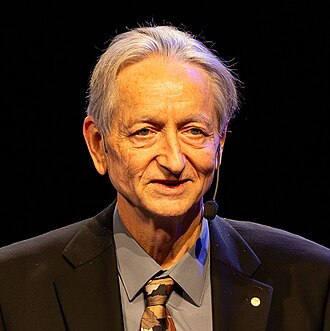
Geoffrey Hinton belongs on Supers because his Canadian story is not just a story of discovery; it is a story of intellectual stubbornness becoming national infrastructure. For years, artificial neural networks sat outside the centre of computer science. Hinton kept working on them anyway, building mathematical tools that helped machines learn from examples instead of following only hand-coded rules. His work at the University of Toronto helped turn a contested research idea into one of the defining technologies of the twenty-first century.
The Canadian Identity
Canada matters in this profile because Toronto gave Hinton something rare: a place where long-horizon research could survive while the wider field moved in other directions. His lab trained students and collaborators who went on to shape modern machine learning. The 2012 ImageNet breakthrough by Hinton, Alex Krizhevsky, and Ilya Sutskever made deep learning impossible to ignore and helped establish Toronto as a central node in the global AI map.
The Achievement
The achievement is technical, but the identity is civic. Hinton shows a Canadian version of scientific power: less theatrical than industrial conquest, more patient, more university-rooted, and eventually world-changing. His 2024 Nobel Prize in Physics, shared with John Hopfield, recognized foundational discoveries and inventions that enable machine learning with artificial neural networks. It also made visible the Canadian research ecosystem behind the modern AI era.
The Legacy
His later public warnings about AI risk add complexity rather than reducing his achievement. Hinton is not simply a builder of the technology; he is one of its most serious critics. That makes the profile more Canadian, not less: public science, in this case, includes responsibility for consequences, governance, and the limits of technical optimism.
Operational Timeline
Born in London, England
Born in London, England.
Develops the academic path that leads into cognitive science, psychology, and computer science
Develops the academic path that leads into cognitive science, psychology, and computer science.
Helps develop neural-network methods including Boltzmann machines
Helps develop neural-network methods including Boltzmann machines.
Joins the University of Toronto, building one of the world's leading AI research centres
Joins the University of Toronto, building one of the world's leading AI research centres.
The Toronto deep-learning breakthrough on ImageNet accelerates the modern AI era
The Toronto deep-learning breakthrough on ImageNet accelerates the modern AI era.
Awarded the Nobel Prize in Physics for work enabling machine learning with artificial neural networks
Awarded the Nobel Prize in Physics for work enabling machine learning with artificial neural networks.