Canadian Astronaut 004
Jeremy Hansen
Fighter pilot. Physicist. The first Canadian to venture beyond low Earth orbit toward the Moon.
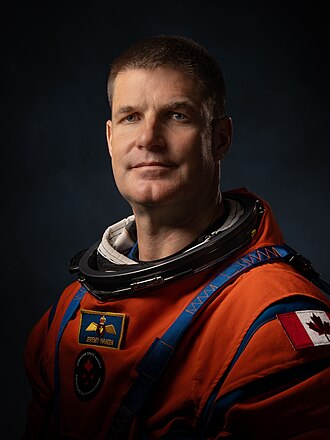
When NASA announced the crew of Artemis II in April 2023, one name made history before the rocket ever left the ground. Colonel Jeremy Hansen, a Canadian Space Agency astronaut, was assigned to become the first Canadian, and the first non-American, to travel beyond low Earth orbit. In April 2026, he did it. This mission was more than just a flight; it was a demonstration of international cooperation and a testament to Canada's indispensable role in the new era of lunar exploration. Hansen became the physical embodiment of a nation's curiosity and its long-standing commitment to the scientific frontier.
Artemis II launched on April 1, 2026, carrying four astronauts around the Moon and back on a nearly ten-day voyage. For Hansen, it was the culmination of a lifetime spent preparing for the unknown—from model airplanes in London, Ontario, to the cockpit of a CF-18 fighter jet, and finally, to the bridge of a lunar-bound spacecraft. The journey covered nearly a million miles of space, taking the crew further from Earth than any humans had traveled since the Apollo era. Hansen’s presence on the mission was the result of decades of technical excellence and a career defined by an unwavering dedication to the pursuit of knowledge under the most extreme conditions.
The Prairies of Flight
Born on January 27, 1976, in London, Ontario, Hansen was raised on a farm near Ailsa Craig. The open fields of the Ontario countryside provided his first glimpses of the vastness that would eventually become his workplace. His fascination with flight began early; as a young boy, he would spend hours building model airplanes and gazing at the stars. At age 12, he joined the Royal Canadian Air Cadets, a program that would prove to be the foundational crucible of his career. The cadets taught him not just the mechanics of flight, but the essential principles of leadership, discipline, and teamwork that are the hallmarks of an astronaut.
Hansen’s progression through the air cadet program was rapid and marked by exceptional achievement. He earned his glider pilot license at age 16 and his private pilot license at age 17, before he even graduated high school. These early successes were not merely about technical skill; they were about the ability to take responsibility for a complex machine and the courage to navigate the three-dimensional environment of the sky. This early mastery of flight set him on a clear path toward the Royal Military College of Canada (RMC) in Kingston, where he earned a Bachelor of Science in Space Science with First Class Honours, followed by a Master of Science in Physics. His academic work, which focused on wide field-of-view satellite tracking, combined his love for the cosmos with a deep understanding of the mathematical and physical laws that govern it.
Supersonic Leadership
Before space, Hansen mastered the skies as a fighter pilot. Flying supersonic jets at low altitude taught him the kind of split-second decision-making that NASA values. He accumulated over 2,500 hours of flight time in more than 20 aircraft types, primarily serving in the Royal Canadian Air Force’s 441 Tactical Fighter Squadron and 409 Tactical Fighter Squadron. His military career was characterized by precision under extreme stress, whether he was conducting NORAD operations in the high Arctic or participating in international exercises in Europe. He eventually rose to the rank of Colonel, a position that reflected his expertise as a pilot and his ability to lead men and women in high-stakes environments.
The transition from fighter pilot to astronaut is a path taken by many of history's greatest explorers, but Hansen brought a unique Canadian perspective to the role. In 2009, he was one of two recruits selected by the Canadian Space Agency from a pool of over 5,000 applicants. His training was exhaustive, covering everything from Russian language studies to wilderness survival and the complex robotics of the Canadarm. He proved himself to be a standout even among his elite peers at NASA, eventually becoming the first Canadian to lead an entire NASA astronaut class as an instructor. This role required him to not only master the technical aspects of spaceflight himself but to find ways to communicate that knowledge to others, a skill that would prove vital during his own mission.
Analog Exploration
Spaceflight requires more than just technical proficiency; it requires the psychological resilience to live and work in confined, high-pressure environments. To prepare for the lunar mission, Hansen participated in several "analog" missions—simulations of space exploration conducted in extreme environments on Earth. In 2013, he was part of the European Space Agency’s CAVES expedition, spending six days living and working in a massive cave system deep beneath the surface of Sardinia. This mission simulated the isolation, darkness, and logistical challenges of space exploration, forcing the crew to rely on their teammates and their training to navigate the unknown.
In 2014, Hansen took part in NASA Extreme Environment Mission Operations (NEEMO) 19, an underwater mission conducted in the Aquarius Reef Base off the coast of Florida. Living in a habitat 60 feet below the surface, the crew performed simulated spacewalks on the ocean floor, testing new technologies and protocols for future missions to asteroids and the Moon. These analog missions were essential components of Hansen’s preparation, allowing him to hone his skills in environments where a simple mistake could have real-world consequences. They also underscored his commitment to the collaborative nature of exploration, a theme that would be central to his role on the Artemis II crew.
Artemis II: The Lunar Frontier
The mission profile for Artemis II was ambitious and historic. On April 6, 2026, Hansen and his crewmates completed their lunar flyby, passing within 6,500 miles of the Moon's surface and reaching a point further from Earth than any humans in history. For Canada, this wasn't just a flight; it was a return on decades of investment in space technology and robotics, proving that deep space has room for everyone willing to work for it. Hansen served as a mission specialist, responsible for monitoring the Orion spacecraft's complex systems and ensuring the success of the mission's primary objectives.
During the flight, Hansen used his position to advocate for the importance of space exploration and the role of international partnership. He spoke directly to students across Canada, sharing his view of the Moon and the Earth from a perspective that only a handful of humans have ever experienced. He described the "overview effect"—the profound shift in awareness that comes from seeing our planet as a fragile, unified whole floating in the vast darkness of space. This message of unity and stewardship was a central part of his mission, a reminder that the ultimate goal of exploring the Moon is to better understand and protect our home planet.
Legacy and the Next Generation
Jeremy Hansen’s impact on Canada extends far beyond his flight time. He is a tireless advocate for STEM (Science, Technology, Engineering, and Mathematics) education, recognizing that the future of exploration depends on the next generation of scientists and engineers. He frequently visits schools and community centers, sharing his story of a farm boy who reached the Moon to inspire others to pursue their own "impossible" dreams. His legacy is one of possibility—the idea that with hard work, discipline, and a willingness to learn, any goal is within reach.
As Canada prepares for its continued role in the Artemis program, including the development of the Canadarm3 for the Lunar Gateway, Hansen remains a central figure in the nation's space program. He is a bridge between the pioneering astronauts of Canada's past and the lunar explorers of its future. His journey is a reminder that while the Moon may be 240,000 miles away, it is closer than ever before, thanks to the vision and dedication of individuals like Colonel Jeremy Hansen. He didn't just go to the Moon; he took a whole nation with him.
Notable Quotes
"Exploration is about more than just where we go; it's about what we learn about ourselves and what we can achieve when we work together toward a common goal."
— Jeremy Hansen
"To see the Earth from deep space is to realize that we are all on the same team, living on a fragile oasis that we must protect for future generations."
— Jeremy Hansen
"I was once just a boy on a farm in Ontario building model airplanes. My journey is proof that if you have a dream and you're willing to work for it, any destination is possible."
— Jeremy Hansen
"The Moon is no longer a destination; it's a proving ground for the human spirit and our collective ability to push the boundaries of the known."
— Jeremy Hansen
Mission Log
Origin
Born in London, Ontario. Raised on a farm near Ailsa Craig with a growing interest in aviation.
Air Cadets
Joins the Royal Canadian Air Cadets at age 12, beginning his formal training in flight and leadership.
Academic Honours
Graduates from the Royal Military College of Canada with a degree in Space Science.
Fighter Pilot
Completes CF-18 fighter pilot training and begins operations with the 441 Tactical Fighter Squadron.
Astronaut Selection
Chosen from 5,351 applicants during the CSA's third recruitment campaign.
NASA Graduation
Graduates from NASA's 20th astronaut class, becoming a fully qualified mission specialist.
CAVES Expedition
Participates in a six-day underground mission in Sardinia to simulate deep-space isolation.
NEEMO 19
Completes a seven-day underwater mission in the Aquarius habitat to test spacewalk protocols.
CAPCOM Role
Serves as the lead Capsule Communicator for multiple International Space Station expeditions.
Artemis II Selection
Publicly named as the first Canadian to fly a crewed mission to the Moon.
Lunar Flyby
Launches April 1st on Artemis II, circles the Moon, and returns safely April 10th.