Technical Portrait 054
John Polanyi
The chemist who read the light from reactions and helped explain molecular change.
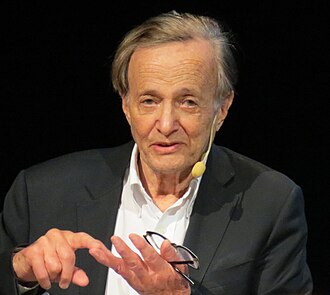
John Polanyi belongs in the Supers collection because his science made invisible molecular events measurable. His work in chemical reaction dynamics helped show how energy is distributed when molecules react. By studying infrared chemiluminescence, the light emitted by reactions, Polanyi opened a way to understand chemical change not just as before-and-after formulas but as physical events with motion, energy, and structure.
He matters because fundamental science changes the scale of human perception. Chemical reactions happen at a level no unaided eye can see, yet they shape life, industry, medicine, atmosphere, and energy. Polanyi helped build methods for reading that hidden world with greater precision.
The Canadian Identity
His Canadian identity is university-centred and international. Born in Berlin to a Hungarian Jewish family, raised and educated in Britain after his family left Europe, Polanyi built his mature scientific career at the University of Toronto. His Nobel Prize in Chemistry in 1986 placed Canadian chemical research on one of the world's highest stages and reinforced Toronto as a serious centre for fundamental science.
Polanyi's life also reflects Canada's role as a place where displaced European intellectual traditions could take root and become part of a new national research culture. His work was not provincial. It was Canadian because it showed Canadian institutions contributing to universal knowledge.
The Achievement
The achievement is technical but beautifully simple in metaphor: reactions give off signals, and Polanyi learned how to read them. His work helped build modern reaction dynamics, connecting laboratory measurement to the deeper question of how matter changes. The Nobel recognized work that made chemistry more precise, more physical, and more visible.
Reaction dynamics changed chemistry by asking not only what products are formed, but how energy moves through the reacting system. Polanyi's experiments helped reveal details of vibrational and rotational energy that connect chemistry with physics. That kind of work does not always produce an immediate public image, but it alters the foundation on which later science stands.
The Legacy
Polanyi's legacy extends beyond the laboratory. He has been an active public voice on nuclear weapons, peace, human rights, and the social responsibilities of scientists. That breadth matters. In the Supers frame, he represents a Canadian ideal of public science: rigorous enough to win a Nobel Prize, and civic enough to ask how knowledge should be used.
His profile also helps correct a narrow idea of achievement. Scientific greatness is not only discovery; it is mentorship, institution-building, public argument, and the defence of humane values. Polanyi's career joins those elements into one long example of responsible intellectual life.
Operational Timeline
Born in Berlin
Born in Berlin, Germany, into a Hungarian Jewish family whose European history shaped the international arc of his life.
Family leaves Europe and Polanyi grows up in Britain
Family leaves Europe and Polanyi grows up in Britain, where his scientific education begins before his move to Canada.
Joins the University of Toronto
Joins the University of Toronto, making Canada the base for the research that would define his career.
Develops landmark work in infrared chemiluminescence and reaction dynamics
Develops landmark work in infrared chemiluminescence and reaction dynamics, helping scientists understand energy flow in chemical reactions.
Shares the Nobel Prize in Chemistry for contributions to chemical reaction dynamics
Shares the Nobel Prize in Chemistry for contributions to chemical reaction dynamics, bringing global recognition to Canadian-based research.
Continues as a public advocate for peace
Continues as a public advocate for peace, human rights, and responsible science, extending his influence beyond chemistry.