Technical Portrait 024
Joseph-Armand Bombardier
The mechanic whose grief drove an obsession to conquer the snow, laying the tracks for a global transportation empire.
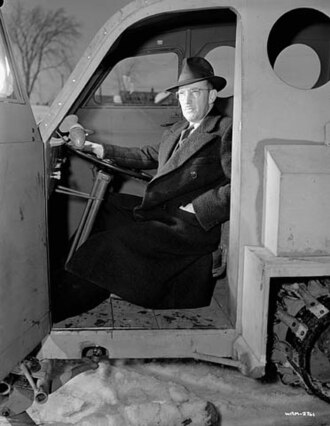
Geography is destiny, particularly in rural Quebec during the early 20th century. For half the year, the landscape was swallowed by snow, severing communities, closing roads, and turning the simple act of traveling into a perilous undertaking. Joseph-Armand Bombardier, a self-taught mechanic with an irrepressible tinkerer's mind, refused to accept this isolation. His obsession with winter mobility would ultimately reshape the Canadian wilderness, transforming the snow from a barrier into a highway. He was a visionary who understood that technology was the key to overcoming the geographical constraints of a vast nation, and his work laid the foundation for a global transportation empire that would eventually touch the skies and the rails of every continent.
Born on April 16, 1907, in Valcourt, Quebec, Bombardier was building mechanical contraptions by the time he was a teenager, famously mounting a Model T Ford engine onto a sled driven by an airplane propeller at age 15. But his pursuit of a reliable snow vehicle became tragically personal in 1934 when his two-year-old son, Yvon, fell ill with peritonitis. Because the roads were entirely impassable due to deep snow, the family could not reach a hospital in time, and Yvon died. This devastating loss catalyzed a relentless drive in Bombardier; it transformed his mechanical curiosity into a life-saving mission. He became determined to ensure that no other family in the rural north would be cut off from essential services by the elements.
The Mechanical Obsession
Bombardier’s childhood was spent in his father’s workshop, where he developed a preternatural understanding of engines and gears. At age 17, he abandoned his studies for the priesthood to pursue an apprenticeship as a mechanic in Montreal, where he soaked up the latest in automotive and industrial technology. When he returned to Valcourt in 1926 to open his own garage, he was already miles ahead of his peers. While he spent his summers repairing the automobiles of local farmers, his winters were dedicated to an endless series of experiments with tracks, skis, and propulsion systems. He was obsessed with the "weight vs. traction" problem—the fundamental challenge of creating a vehicle heavy enough to generate power but light enough to stay on top of the snow.
His early prototypes were often dangerous and loud, terrifying the local livestock and occasionally his neighbors. He experimented with everything from wooden slats to metal chains, but the breakthrough remained elusive until he began looking at rubber. He realized that the key to mobility in deep snow was flexibility and surface area. He needed a track that could deform over obstacles and a drive system that wouldn't clog with ice. This period of trial and error, conducted in the quiet of his Valcourt garage, was the research and development phase for an entire industry. Every failure taught him something new about the physics of winter, and every small success brought him closer to the vehicle that would change everything.
The Sprocket Wheel Innovation
His breakthrough arrived in 1935 with the invention of a revolutionary sprocket wheel and track system. Unlike previous attempts at snow vehicles that used heavy, rigid tracks, Bombardier’s system used rubber-covered wheels and flexible rubber belts, allowing the vehicle to "float" over deep snow rather than sinking. In 1937, he patented the system and released his first commercial vehicle: the B7 (Bombardier, 7 passengers), an enclosed half-track that quickly became essential for rural doctors, postal workers, and school transport. The B7 was more than a vehicle; it was a lifeline. It allowed a doctor to reach a patient in the middle of a blizzard and ensured that the mail reached isolated hamlets even in the dead of winter.
The success of the B7 led to the development of the larger B12 in 1941, which could carry twelve passengers and was used extensively across the Canadian Arctic. During World War II, the Canadian government recognized the strategic value of Bombardier's technology and commissioned him to develop armored tracked vehicles for the military. This required a massive expansion of his production facilities and a shift from artisan manufacturing to industrial assembly. The lessons learned during the war—about reliability, durability, and mass production—would prove vital in the post-war years. Bombardier was no longer just an inventor; he was an industrialist at the head of a growing company, L'Auto-Neige Bombardier Limitée, that was becoming a source of pride for all of Quebec.
As the business grew, the provincial government began plowing rural roads in the late 1940s, wiping out the demand for his large passenger snow-coaches overnight. Most entrepreneurs would have folded, seeing their primary market disappear under the blade of a snowplow. Bombardier, however, saw it as a challenge. He realized that if people didn't need the snowmobile for survival, they might want it for something else entirely: pleasure. This pivot from utility to recreation was one of the most brilliant strategic moves in Canadian business history. He began working on a smaller, lighter version of his technology that could be used by individuals for hunting, fishing, and exploring the winter landscape.
The Ski-Doo Phenomenon
Leveraging lighter engines and a new process for vulcanizing rubber to create continuous tracks, he scaled down his technology to create a personal, recreational snowmobile. Originally intended to be named the "Ski-Dog," a typographical error in the marketing materials changed it to the Ski-Doo. Launched in 1959, the Ski-Doo didn't just create a new product category; it invented an entire winter sport, transforming the snowy months from a season of endurance into one of recreation. The Ski-Doo was agile, fast, and relatively affordable, making the wilderness accessible to everyone. It fundamentally changed the culture of rural Canada, creating a new way for people to connect with the land and with each other during the long winters.
The impact of the Ski-Doo was particularly profound in the Arctic and sub-Arctic regions, where it quickly replaced the dog sled as the primary mode of transportation for Indigenous communities. While this shift brought about complex social changes, there was no denying the increased mobility and safety the snowmobile provided. Bombardier's invention allowed people to travel further and faster than ever before, expanding the possibilities for hunting, trapping, and community interaction. He remained deeply involved in the design and production of the Ski-Doo until the very end, always looking for ways to make it lighter, faster, and more reliable. He was a man who lived and breathed his work, driven by a desire to see his inventions in every snowy corner of the globe.
The Enduring Legacy
Bombardier died of cancer in 1964, before he could see his modest garage operation evolve into a multinational aerospace and transportation conglomerate. Yet, his fundamental legacy remains bound to the snow: he gave people the power to move freely through the harshest of Canadian winters. After his death, his son-in-law, Laurent Beaudoin, took the helm of the company and led an aggressive period of diversification. Bombardier Inc. acquired the Montreal Metro contract, and then expanded into the aerospace industry with the acquisition of Canadair, Learjet, and De Havilland. Today, the name Bombardier is synonymous with high-speed trains and luxury business jets, a far cry from the wooden sleds of 1922, but still guided by the same spirit of innovation.
In his hometown of Valcourt, the Museum of Ingenuity J. Armand Bombardier preserves his original workshop and a vast collection of his prototypes. It serves as a reminder of what one person can achieve with a clear vision and a relentless work ethic. Bombardier was a hero of the "quiet revolution" in Quebec, proving that a French-Canadian entrepreneur could build a global company from the ground up. He is remembered not just for the machines he built, but for the obstacles he overcame—both mechanical and personal. He was the winter innovator, the man who looked at the frozen landscape and saw not a barrier, but a beautiful, endless possibility.
Notable Quotes
"I never lost my dream of motorized snow travel. Every obstacle was just a lesson in how to build a better track."
— Joseph-Armand Bombardier
"The best way to predict the future is to invent it yourself, one gear at a time."
— Joseph-Armand Bombardier
"Innovation is the child of necessity and the grandchild of persistence."
— Joseph-Armand Bombardier
"We didn't just build a machine; we built a way for people to stay connected when the world turns white."
— Joseph-Armand Bombardier
Operational Timeline
Origin
Joseph-Armand Bombardier is born in Valcourt, Quebec. Shows early mechanical genius in his father's workshop.
First Prototype
Builds his first propeller-driven snow vehicle at age 15 using a Model T engine and wooden sleds.
The First Garage
Opens his own garage in Valcourt, Quebec, funded by a loan from his father.
Personal Tragedy
The death of his son due to impassable winter roads fuels his determination to build a reliable snow vehicle.
The B7 Snowmobile
Patents the revolutionary sprocket wheel/track system and begins selling the 7-passenger B7 snow-coach.
The B12 Launch
Releases the larger B12 model, which becomes a staple for transport in the Canadian Arctic.
L'Auto-Neige
Founds L'Auto-Neige Bombardier Limitée to manufacture military and commercial tracked vehicles.
Policy Shift
Quebec begins plowing rural roads, forcing Bombardier to rethink his business model and focus on recreation.
The Muskeg
Develops the Muskeg tractor, an all-terrain vehicle capable of traversing swamps and muskeg.
The Ski-Doo
Launches the first personal, recreational snowmobile, fundamentally changing winter recreation globally.
Final Sign-off
Joseph-Armand Bombardier passes away at age 56, leaving behind a thriving industrial legacy.
Museum Opening
The J. Armand Bombardier Museum opens in Valcourt to preserve and showcase his work.