Arts & Culture 011
Kenojuak Ashevak
The Matriarch of Cape Dorset. A visual visionary who translated the rhythms of Arctic life into an international language of line and color.
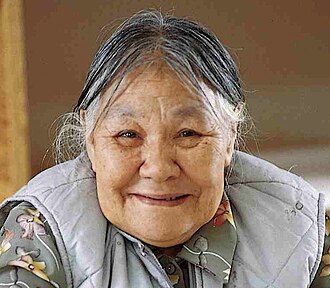
Kenojuak Ashevak was a visionary force of nature who transformed the stark, rhythmic beauty of the Arctic into a globally recognized language of graphic brilliance. Born in an igloo and raised in the nomadic tradition of the Inuit, she bridged the gap between a prehistoric way of life and the modern international art world with a pencil and a stonecut. Her "primary power" was a graphic clarity so profound that it didn't just capture the likeness of the northern wildlife; it captured the spirit of transformation that defines the Arctic soul. As the matriarch of modern Inuit art, her legacy is etched into the very identity of Canadian culture, proving that the most powerful visions often emerge from the most remote corners of the world.
Her most famous work, The Enchanted Owl (1960), is perhaps the most iconic piece of Canadian art ever created, a masterpiece of symmetry and radiating energy that feels both ancient and startlingly contemporary. It features a bird with radiating plumage that feels both prehistoric and modern—a testament to her "primary power" of graphic clarity. She once said, "I just take these things out of my thoughts and out of my mind, and I don't really think about them that much. I just think of what I can see and then I start drawing it." This intuitive approach allowed her to produce thousands of works over five decades, each one a testament to her unique ability to see the extraordinary within the ordinary.
The Life of the North
Kenojuak Ashevak’s journey began on October 3, 1927, at Ikirasaq, a seasonal camp on the southern coast of Baffin Island. Her early years were defined by the cycles of the land and the sea, a semi-nomadic existence where survival depended on an intimate knowledge of the environment and a deep respect for the animals that sustained the Inuit people. Her father, Ushaquak, was a respected hunter and shaman, a man whose spiritual connection to the natural world would leave a lasting impression on Kenojuak’s creative imagination. He was a figure of authority and mystery, and his stories of the spirit world—where animals and humans could shift forms—became the foundation for her later artistic explorations.
The transition from this traditional lifestyle to the modern era was marked by profound personal struggle. In 1946, Kenojuak was married to Johnniebo Ashevak in a traditional arrangement. While the marriage was initially one of necessity, it grew into a deep partnership of mutual respect and shared creativity. However, the early 1950s brought a devastating blow: Kenojuak contracted tuberculosis. At the time, the disease was a scourge in the North, and the standard treatment involved being transported thousands of miles south to specialized hospitals. From 1952 to 1955, Kenojuak was confined to the Parc Savard Park Hospital in Quebec City. This period of isolation was traumatic—she was separated from her family, her culture, and the land she loved. Yet, it was also during this time that her artistic potential began to flicker into life.
In the hospital, to pass the time and combat the crushing boredom of convalescence, Kenojuak began to experiment with beadwork and small crafts. It was here that she first met James Houston, a civil servant and artist who was scouting for Indigenous talent to help develop a northern craft industry. Houston recognized the inherent grace in Kenojuak’s work, but it would be several more years before she fully committed to the path of an artist. When she finally returned to the North in 1955, she found her community in the midst of a radical transformation. The semi-nomadic camps were being replaced by permanent settlements like Kinngait (Cape Dorset), and the traditional hunting economy was shifting toward a wage-based system. It was in this crucible of change that the West Baffin Eskimo Co-operative was born.
The West Baffin Cooperative
Ashevak was instrumental in the success of the West Baffin Eskimo Co-operative, the first of its kind in the Arctic. Along with James Houston and her husband Johnniebo Ashevak, she developed the specialized techniques of stonecut and stencil printmaking. This model didn't just create art; it created economic sovereignty for the Inuit community, turning Cape Dorset into the printmaking capital of the world. The cooperative provided a space where Inuit artists could translate their traditional knowledge into a medium that was accessible to the southern market, and Kenojuak quickly emerged as its brightest star.
The technical process of stonecut printmaking was a collaborative effort. Kenojuak would provide the drawings—often using simple graphite or felt-tip pens—and then skilled carvers like Iyola Kingwatsiak or Lukta Qiatsuk would translate those lines onto large blocks of flattened soapstone. The stones were then inked and pressed onto paper to create the final prints. This process required a remarkable degree of synergy; the carver had to capture the "energy" of Kenojuak’s line without losing the raw power of her original vision. Kenojuak’s work was particularly well-suited to this medium, as her designs were characterized by bold, clean lines and a powerful sense of balance that resonated even when translated through multiple hands.
Throughout the 1960s and 70s, Kenojuak’s reputation grew exponentially. Her work travelled from the small cooperative in Kinngait to the National Gallery of Canada, the MET, and onto the vertical surfaces of Canadian currency. She became a global ambassador for Inuit culture, travelling to exhibitions in Europe, Japan, and across North America. Despite her international fame, she remained deeply rooted in her community. She continued to live in Cape Dorset, raising her children and participating in the daily life of the settlement. For Kenojuak, art was not a pursuit of individual glory; it was a way of honoring her ancestors and ensuring the survival of her people’s stories in a changing world.
The Graphic Vision
What set Kenojuak apart was her "Primary Power" of Graphic Vision. Her work was never about literal representation; she wasn't interested in drawing a "realistic" owl or a "naturalistic" caribou. Instead, she was interested in the *idea* of the animal, the way its form interacted with the space around it, and the spiritual energy it contained. Her birds often possessed multiple heads or radiating feathers that looked like sunbursts, suggesting a state of perpetual movement and transformation. This was a direct reflection of the Inuit worldview, where the boundaries between the physical and spiritual realms are fluid and ever-shifting.
In her later years, Kenojuak’s style evolved to include more vibrant colors and even more complex compositions. She began to experiment with different media, including oil pastels and large-scale drawings that allowed her to explore the limits of her imagination. Yet, her core principles remained the same: a focus on balance, symmetry, and the inherent beauty of the line. She was a master of "filling the page," an Inuit aesthetic where the entire surface of the paper is utilized to create a sense of completeness and harmony. Her ability to maintain this level of creative intensity for over half a century is a testament to the depth of her vision and the resilience of her spirit.
The Enduring Legacy
Kenojuak Ashevak’s impact on Canada and the global art community is immeasurable. She didn't just create beautiful objects; she changed the way the world perceived Indigenous people and their creative output. Before Kenojuak, Inuit art was often dismissed as "primitive" or "ethnographic" by the southern establishment. She, along with her contemporaries in Cape Dorset, forced the art world to recognize Inuit prints and drawings as serious, sophisticated works of modern art. She broke down the barriers of the gallery system, proving that a woman from a remote Arctic camp could stand alongside the greatest artists of the 20th century.
In 2017, the Bank of Canada included her work on a special edition $10 note—the first time an Inuit artist was so honored—ensuring her vision remains part of the country's daily exchange. Her name is immortalized in the Kenojuak Cultural Centre and Print Shop in Kinngait, a state-of-the-art facility that serves as a hub for the next generation of Inuit creators. She received almost every honor a Canadian artist can achieve, including the Order of Canada, the Governor General’s Award in Visual and Media Arts, and induction into Canada's Walk of Fame. Yet, perhaps her most lasting legacy is the sense of pride and possibility she instilled in her community. She proved that the Inuit voice was not just a relic of the past, but a vibrant, essential part of the global future.
Notable Quotes
"I just take these things out of my thoughts and out of my mind, and I don't really think about them that much. I just think of what I can see and then I start drawing it."
— Kenojuak Ashevak
"I try to make things which look good to me, which please my eye. I am not trying to make a copy of any particular animal."
— Kenojuak Ashevak
"Drawing was the only thing I could do, and I'm very happy that I can do it. It's my life."
— Kenojuak Ashevak
Operational Timeline
Origin
Born at Ikirasaq on the south coast of Baffin Island. Named after her maternal grandfather.
Partnership
Marries Johnniebo Ashevak, beginning a lifelong collaboration in art and survival.
Confinement
Sent to Quebec City for three years of tuberculosis treatment. Begins experimenting with crafts.
First Drawing
Encouraged by James Houston, she creates her first drawing, "Rabbit Eating Seaweed".
Cape Dorset Prints
Co-founds the West Baffin Eskimo Co-operative, establishing a permanent studio for Inuit artists.
The Breakout
Releases 'The Enchanted Owl', which becomes the definitive symbol of Inuit graphic art.
Order of Canada
Appointed as an Officer of the Order of Canada, one of the first Inuit to be so honored.
Philatelic Fame
'The Enchanted Owl' is featured on a 6-cent Canadian postage stamp, reaching millions.
Companion
Promoted to Companion of the Order of Canada, the highest level of the order.
Highest Honor
Receives the Governor General's Award in Visual and Media Arts.
Final Departure
Kenojuak passes away in Cape Dorset at the age of 85, mourned by the international art community.
Currency of Vision
The Bank of Canada releases a $10 bill featuring her work 'Owl’s Bouquet' to mark Canada 150.
Living Legacy
The Kenojuak Cultural Centre in Kinngait continues to mentor the next generation of graphic artists.