Technical Portrait 050
Lincoln Alexander
The public servant who turned firsts into open doors for others.
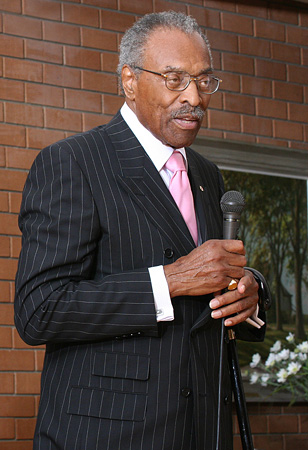
Lincoln Alexander matters because he turned a series of firsts into a public ethic. He became Canada's first Black member of Parliament, later a federal cabinet minister, and then Ontario's first Black lieutenant-governor. Those milestones are important, but the deeper significance is how he carried them: with directness, humour, institutional seriousness, and a constant insistence that public life should open doors for people previously kept outside.
A profile of Alexander is not only a profile of representation. It is a profile of civic presence. He entered institutions that had not been built with people like him in mind and then used his visibility to encourage education, participation, and confidence in others.
The Canadian Identity
His Canadian identity was shaped by Hamilton, military service, labour, law, politics, and the Black Canadian experience of discrimination and persistence. Alexander knew what exclusion felt like. He also believed strongly in the possibility of public service. That combination gave his career moral weight: he loved the country enough to serve it and understood it clearly enough to challenge it.
Hamilton is central to that identity. Alexander's public voice carried the practicality of a working city. He was not a distant ceremonial figure even when he held ceremonial office. He remained connected to schools, young people, community events, and the everyday work of belonging.
The Achievement
His election to Parliament in 1968 was a landmark in Canadian democracy. It placed a Black Canadian in the House of Commons for the first time and made visible a possibility that should never have taken so long. His later service as minister of labour and lieutenant-governor showed that the breakthrough was not symbolic only; he could operate across the full range of public responsibility.
As lieutenant-governor of Ontario, Alexander brought warmth and accessibility to an office that can otherwise feel remote. He emphasized education, youth, anti-racism, and civic duty. That work helped transform a constitutional role into a platform for encouragement and public memory.
The Legacy
His legacy is now carried through Lincoln Alexander Day, schools, awards, and the many public servants who cite him as a model. The phrase "first Black MP" will always attach to his name, but it should not limit him. He was also a lawyer, veteran, parliamentarian, mentor, and civic teacher.
Alexander's larger lesson is that representation has to become responsibility. He did not treat being first as a finish line. He treated it as a way to make second, third, and thousandth possible.
Operational Timeline
Born in Toronto
Born in Toronto, Ontario, into a Black Canadian family whose experiences shaped his understanding of racism and public responsibility.
Serves in the Royal Canadian Air Force during the Second World War
Serves in the Royal Canadian Air Force during the Second World War, adding military service to his public identity.
Graduates from Osgoode Hall Law School and enters the legal profession after...
Graduates from Osgoode Hall Law School and enters the legal profession after overcoming barriers to opportunity.
Elected as Canada's first Black member of Parliament
Elected as Canada's first Black member of Parliament, representing Hamilton West and changing the face of federal politics.
Serves as federal minister of labour
Serves as federal minister of labour, expanding his role from parliamentary breakthrough to cabinet responsibility.
Becomes Ontario's first Black lieutenant-governor
Becomes Ontario's first Black lieutenant-governor, bringing accessibility and youth focus to the vice-regal office.
Lincoln Alexander Day is observed nationally
Lincoln Alexander Day is observed nationally, turning his life into an annual civic reminder.