Technical Portrait 016
Margaret Atwood
The architect of dystopia whose pen weaves futures so sharp they consistently bleed into the present.
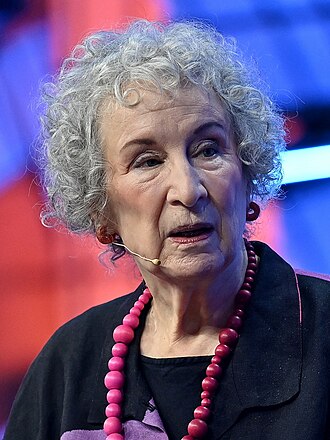
When Margaret Atwood constructs a world, she does not invent horrors from whole cloth; she merely rearranges the fabric of human history. Her fiction operates less as escapism and more as a high-resolution mirror, reflecting the darkest capacities of society, particularly regarding power dynamics, environmental degradation, and the subjugation of women. With a razor-sharp intellect and an unflinching gaze, she has cemented herself as the matriarch of modern speculative literature. Her "primary power" is a diagnostic foresight so precise that it often feels like prophecy, though she insists it is merely the logical conclusion of observable trends.
Born in Ottawa, her early life was steeped in the wilderness of northern Quebec and Ontario, where her father worked as an entomologist. This deep, early immersion in nature instilled in her a profound understanding of ecosystems—an awareness that heavily colors her later works, particularly the MaddAddam trilogy. She began writing at age six, and by sixteen, realized it was the only path forward. Over the next seven decades, she would produce a staggering body of work encompassing poetry, novels, literary criticism, and graphic novels, becoming one of the most recognizable and influential writers in the world. Her voice, characterized by a dry, darkly humorous observation, has become a definitive sound of the modern Canadian consciousness.
The Life of the Bush and the Library
Margaret Eleanor Atwood was born on November 18, 1939, just as the world was descending into the chaos of World War II. Her father, Carl Edmund Atwood, was an entomologist whose research on forest insects required the family to spend long periods in the remote bush of northern Quebec and Ontario. For much of her childhood, Margaret did not attend traditional school; instead, she was educated by her parents and the vast, indifferent wilderness. This unconventional upbringing fostered a precocious independence and a deep, biological understanding of the cycle of life and death. She spent her days reading, drawing, and observing the natural world—experiences that would later inform her belief that nature is not a backdrop, but a powerful, often hostile force that must be reckoned with.
The family finally settled in Toronto in 1946, a transition that Atwood found jarring. The suburban rituals of the post-war era seemed as alien to her as the behavior of insects. She attended Victoria College at the University of Toronto, where she was mentored by the legendary literary critic Northrop Frye. Frye’s theories on myth and archetype provided Atwood with a structural framework for her burgeoning creativity. She then moved to Harvard University (Radcliffe College) for her graduate studies, an experience that introduced her to the complexities of gender and power in the American academic establishment. It was during this time that she began to publish her first collections of poetry, establishing herself as a formidable new voice in Canadian literature. Her poems were sharp, unsentimental, and deeply concerned with the ways in which language can both reveal and obscure the truth.
Throughout the 1960s and 70s, Atwood lived a nomadic academic life, teaching at various universities across Canada and the United States. This period was marked by an explosion of creative energy. She published her first novel, The Edible Woman (1969), a proto-feminist satire that explored the commodification of women's bodies. She also released Survival: A Thematic Guide to Canadian Literature (1972), a revolutionary work of criticism that posited "survival" as the central motif of the national literary identity. By the time she moved to West Berlin in the early 1980s, she was already a major figure in Canadian letters, but it was there, in the shadow of the Berlin Wall, that she would write the novel that would transform her into a global icon.
The Speculative Mirror
Atwood staunchly categorizes her most famous work, The Handmaid’s Tale (1985), not as science fiction, but as "speculative fiction." Her guiding principle was chillingly simple: she included no atrocity in the novel that had not already occurred somewhere in human history. The novel, set in the near-future theocratic regime of Gilead, explores the total subjugation of women in a society grappling with environmental collapse and infertility. It was a visceral reaction to the rise of the religious right in the United States and the persistent vulnerabilities of women's rights globally. Decades later, the novel's red cloaks and white bonnets have transcended literature to become global symbols of feminist resistance, appearing at protests from Washington to Warsaw.
Her literary range continued to expand in the following decades. She explored historical fiction with Alias Grace (1996), a chilling account of a 19th-century murder, and won the Booker Prize for The Blind Assassin (2000), a complex, multi-layered narrative that blended social history with pulp science fiction. However, she returned to the dystopian mode with the MaddAddam trilogy (starting with Oryx and Crake in 2003), a sprawling, bio-punk epic that explored the consequences of genetic engineering and corporate greed. These novels were even more prescient than The Handmaid's Tale, anticipating the rise of gene editing, lab-grown meat, and the catastrophic impact of climate change. For Atwood, the future is not something that happens to us; it is something we are actively building through our choices in the present.
Her literary voice is characterized by a surgical precision and a refusal to offer easy consolations. She dismantles patriarchal structures and national myths with a dry, often biting wit. Her characters are rarely heroes in the traditional sense; they are survivors, often compromised and morally ambiguous, who must navigate systems designed to crush them. This unflinching realism, combined with her vast imaginative scope, has made her a vital witness to the complexities of the 21st century. She is a writer who understands that the greatest threat to humanity is not the wilderness, but the stories we tell ourselves to justify our own cruelty.
The Legacy of the Word
Margaret Atwood’s impact on Canada and the global literary community is immeasurable. She didn't just write books; she helped to create the infrastructure for a national literature, co-founding the Writers' Trust of Canada and advocating for the rights of authors in an increasingly digital world. She is a cultural colossus, a double Booker Prize winner whose work has been translated into dozens of languages and adapted for stage, screen, and even opera. Her influence is felt in every writer who tackles the intersection of gender, power, and the environment. She has proven that "Canadian literature" is not a parochial concern, but a powerful, essential lens through which the entire world can be understood.
Beyond her writing, Atwood is a formidable public intellectual and activist. She is a fierce advocate for environmental conservation, serving as the honorary president of BirdLife International’s Rare Bird Club. She is also a pioneer in literary technology, inventing the "LongPen," a device that allows authors to sign books remotely—a testament to her pragmatic, forward-thinking nature. Even in her eighties, she remains a piercing voice on social issues, using her platform to challenge authoritarianism and defend the freedom of expression. She is the architect of our darkest fictional futures, but she is fundamentally concerned with ensuring we have the wisdom to avoid them in reality. Her legacy is a testament to the power of the word to warn, to witness, and ultimately, to survive.
Notable Quotes
"A word after a word after a word is power."
— Margaret Atwood, from 'Spelling'
"Better never means better for everyone... It always means worse, for some."
— Margaret Atwood, from 'The Handmaid's Tale'
"Nature is not a temple, but a workshop more like, and we are the tools."
— Margaret Atwood
"If I waited for perfection... I would never write a word."
— Margaret Atwood
Operational Timeline
Origin
Born in Ottawa. Spends her early years in the remote bush of northern Quebec and Ontario.
Double Persephone
Wins the E.J. Pratt Medal for her first collection of poems, published while at the University of Toronto.
The Circle Game
Publishes her first major poetry collection, winning the Governor General's Award and establishing her national reputation.
The Edible Woman
Releases her debut novel, a satirical exploration of consumerism and gender roles.
Survival
Publishes her seminal guide to Canadian literature, defining 'survival' as the core national theme.
The Handmaid's Tale
Publishes her most famous work, a dystopian masterpiece that wins the first-ever Arthur C. Clarke Award.
Alias Grace
Explores historical fiction and the ambiguity of truth, winning the Giller Prize.
First Booker Prize
Wins the prestigious Booker Prize for 'The Blind Assassin,' a multi-layered narrative tour de force.
Oryx and Crake
Begins the MaddAddam trilogy, exploring the catastrophic intersections of genetic engineering and climate change.
Cultural Resonance
The TV adaptation of 'The Handmaid's Tale' launches, bringing her vision to a new global audience during a period of political upheaval.
The Testaments
Releases the sequel to 'The Handmaid's Tale,' winning a second Booker Prize and setting sales records.
Living Legend
Continues to publish and advocate, remaining one of the world's most vital voices on environmental and social justice.