Arts & Culture 008
Oscar Peterson
The Maharajah of the keyboard. A virtuosic force who turned Montreal's Little Burgundy into the center of the jazz universe.
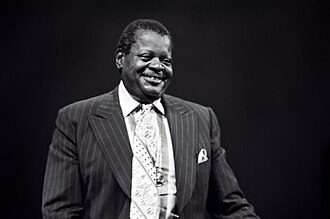
Duke Ellington called him the "Maharajah of the keyboard." To everyone else, Oscar Peterson was a force of nature, a man who transformed the eighty-eight keys of the piano into a shimmering, swinging orchestra. Born in Montreal's Little Burgundy, he practiced up to 18 hours a day, developing a technique so flawless and a sense of swing so deep that he became the international gold standard for jazz piano. His "primary power" was a virtuosic mastery that combined the speed of light with the weight of a freight train, allowing him to navigate the most complex harmonic landscapes with effortless grace and infectious joy.
Throughout a career that spanned seven decades, Peterson recorded over 200 albums and performed with nearly every major figure in the history of jazz. He was a master of the trio format, leading legendary groups that redefined the relationship between the piano, bass, and guitar. But beyond his technical brilliance, he was a deeply sensitive artist who used his music to address the social issues of his time. His "Hymn to Freedom" became an anthem for the civil rights movement, proving that jazz was not just a form of entertainment, but a powerful tool for social change. Today, his legacy is etched into the very fabric of Canadian culture, a reminder that the highest levels of artistic excellence are born of relentless discipline and an unwavering commitment to the spirit of the music.
The Life of a Keyboard King
Oscar Emmanuel Peterson was born on August 15, 1925, in Montreal, Quebec. He grew up in the neighborhood of Little Burgundy, a vibrant hub of the city’s Black community and a fertile ground for musical talent. His father, Daniel Peterson, was a porter for the Canadian Pacific Railway and an amateur musician who insisted that all five of his children learn an instrument. For Oscar, music was not a hobby; it was a way of life, enforced by his father’s rigorous practice schedule. Initially a trumpet player, Oscar switched to the piano at the age of seven after a bout of tuberculosis weakened his lungs. He was mentored by his older sister, Daisy Peterson Sweeney, a renowned teacher who would go on to instruct many of Montreal’s most famous jazz musicians. Under her guidance, Oscar developed a strong foundation in classical music, which he would later blend with the rhythms of boogie-woogie and stride piano.
By his mid-teens, Peterson was already a local sensation. He won a national radio talent show in 1940 and soon dropped out of high school to pursue music full-time. He joined the Johnny Holmes Orchestra, one of the most popular big bands in Canada, where he honed his skills as a soloist and arranger. However, it was his 1949 debut at Carnegie Hall that catapulted him onto the world stage. Discovered by the legendary impresario Norman Granz, who heard Peterson playing on the radio while riding in a taxi in Montreal, Oscar was brought to New York as a "surprise guest" for a Jazz at the Philharmonic concert. His performance stunned the audience and the critics alike, establishing him as the successor to Art Tatum and the new king of the jazz piano. Despite the sudden fame, he remained a quintessential Canadian: modest, hardworking, and deeply devoted to his craft.
The 1950s and 60s were the golden years of the Oscar Peterson Trio. He formed a legendary partnership with bassist Ray Brown and guitarist Herb Ellis (later replaced by drummer Ed Thigpen), creating a group that was famous for its telepathic communication and unstoppable drive. They toured the world relentlessly, bringing Peterson’s brand of high-octane swing to every corner of the globe. Yet, life on the road was not without its challenges. As a Black man travelling through the segregated United States, Peterson frequently encountered racism and discrimination—experiences that deeply affected him and eventually led him to take a more active role in the civil rights movement. He refused to perform in venues that did not allow integrated audiences, using his stature as an international star to demand respect and equality for all musicians.
Technical Architecture
Peterson treated the piano as a full orchestra. His style was built on an orchestral approach that utilized the entire range of the keyboard, from the thunderous bass notes to the crystal-clear upper register. He frequently employed a "locked-hands" style—using block chords to create a massive, shimmering wall of sound that could compete with any big band. His legendary walking tenths in the left hand provided a self-sufficient harmonic and rhythmic foundation that made a bassist almost optional. He was a master of the "stride" technique, but he updated it with modern harmonies and a relentless, driving energy that was uniquely his own.
His right hand was often described as having the precision of a "prizefighter." He could execute chromatic runs and complex bebop patterns at extreme velocities without ever losing clarity or rhythmic poise. He seamlessly blended the earthy, gospel-influenced riffs of the blues with the dazzling, multi-octave arpeggios of classical impressionism. For Peterson, the piano was not just a percussion instrument; it was a singing voice, and he spent his entire life refining the "touch" that allowed him to draw an infinite variety of colors and textures from the strings. His choice of the Bösendorfer Imperial grand piano, with its extra keys and rich, resonant sound, was a testament to his desire for the ultimate musical expression.
The Work: Canadiana and Freedom
While Peterson was primarily known as a performer, his work as a composer was equally significant. Released in 1964, the Canadiana Suite is his most ambitious compositional achievement. Structured as a musical portrait of his homeland, it takes the listener on a conceptual railway journey from the Atlantic to the Pacific. In "Place St. Henri," he pays tribute to his Montreal roots with a runaway-train tempo and relentless stride piano that captures the bustling energy of the neighborhood. In "Laurentide Waltz," he uses rapid-fire arpeggios to mimic an avalanche of snow in the Quebec mountains, while "Hogtown Blues" offers a gritty, soulful look at Toronto. The suite remains a landmark in Canadian jazz, a rare example of a jazz musician using the idiom to explore national identity.
His most famous composition, however, is undoubtedly "Hymn to Freedom." Written in 1962 at the height of the American civil rights movement, the piece was inspired by the gospel music of his youth and the struggles for equality he witnessed on his tours. With its simple, soaring melody and powerful rhythmic build, the hymn resonated deeply with audiences around the world. It was adopted as an anthem by the movement, and Peterson often performed it to close his concerts, a musical plea for peace and understanding. He understood that music had a unique power to transcend language and politics, and he used that power to advocate for a more just and inclusive world. The hymn remains one of the most enduring and beloved pieces in the jazz canon.
The Legacy of the Maharajah
Oscar Peterson’s impact on jazz and Canadian culture is immeasurable. He was a mentor to countless young musicians, establishing the Advanced School of Contemporary Music in Toronto in 1960 to provide a space for the study of jazz at a time when it was still largely ignored by traditional conservatories. He received almost every honor a musician can achieve, including eight Grammy Awards, the Juno Award for Hall of Fame, and the Glenn Gould Prize. He was a Companion of the Order of Canada and the recipient of numerous honorary doctorates. Yet, he never lost his sense of curiosity or his drive to improve. Even after a debilitating stroke in 1993 that limited the use of his left hand, he continued to perform and record, adapting his technique with a resilience that inspired fans around the world.
Today, his name is immortalized in monuments, parks, and even a commemorative circulation coin released by the Royal Canadian Mint in 2022. But his true legacy is found in the recordings he left behind—a massive body of work that continues to inspire and challenge piano players of all generations. He proved that a Black man from a working-class neighborhood in Montreal could reach the very pinnacle of the international music world through talent, hard work, and an unshakeable belief in the power of art. He was the "Maharajah of the keyboard," a man who played with the heart of a poet and the strength of a king, ensuring that the spirit of swing will live on forever.
Notable Quotes
"It's the group that counts. You don't have to be the star. You have to be part of the music."
— Oscar Peterson
"I believe in the piano as a complete instrument. I want it to sound like an orchestra."
— Oscar Peterson
"I'm still learning. Every time I sit down at the piano, I find something new."
— Oscar Peterson
Operational Timeline
Origin
Born in Montreal's Little Burgundy. Begins musical training on trumpet before switching to piano at age seven.
First Breakthrough
Wins the Ken Soble amateur show on the radio, launching his professional career as a teenager.
Johnny Holmes Orchestra
Joins one of Canada's most popular big bands, refining his skills as a soloist and arranger.
Carnegie Hall
Introduced by Norman Granz, he stuns the New York jazz scene and begins his global ascent.
The First Trio
Forms his legendary trio with Ray Brown and Herb Ellis, redefining the piano-bass-guitar dynamic.
Advanced School of Music
Founds a school for contemporary music in Toronto to mentor the next generation of jazz artists.
Hymn to Freedom
Composes a definitive anthem for the civil rights movement, blending gospel and jazz into a plea for equality.
Canadiana Suite
Releases his most significant compositional work, a musical journey across the Canadian landscape.
Order of Canada
Appointed an Officer of the Order of Canada, later promoted to Companion in 1984.
The Stroke
Suffers a major stroke that impacts his left hand. He miraculously returns to performing within a year.
Final Farewell
Oscar Peterson passes away at his home in Mississauga at the age of 82.
National Currency
Honoured with a commemorative circulation coin, cementing his status as a Canadian icon.