Space & Science 005
Roberta Bondar
Astronaut. Neurologist. A scientist with an artist's eye for the fragility of our planetary systems.
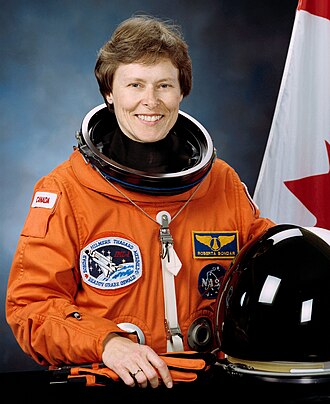
Roberta Bondar went to space with more than courage. She brought medicine, neuroscience, observation, and the discipline of a photographer. On January 22, 1992, she launched aboard space shuttle Discovery on STS-42, becoming the first Canadian woman in space and the first neurologist to travel there. Her journey was not just a flight across the atmosphere, but a deliberate scientific inquiry into the very nature of human existence in an environment where gravity—the constant companion of all life on Earth—is suddenly and profoundly absent.
The mission studied how microgravity affects living systems. Bondar's work fit a larger question: what happens to human perception, balance, and the nervous system when the body leaves the environment that shaped it? She transformed her orbit into a laboratory for the future of human biology in the stars. Her dual role as an astronaut and a medical doctor allowed her to bridge the gap between abstract physics and the biological reality of the human frame, providing insights that remain foundational to space medicine today.
The Scientific Origin
Born on December 4, 1945, in Sault Ste. Marie, Ontario, Roberta Bondar’s fascination with science began in the most literal of foundations: her father’s basement. There, she built a laboratory where she conducted experiments that would foreshadow a lifetime of rigorous inquiry. She wasn't just interested in one field; she wanted to understand how everything connected. This multidisciplinary curiosity led her to a path of academic achievement that is virtually unparalleled in the history of the Canadian astronaut corps.
By the time she was selected for spaceflight, Bondar had earned four university degrees, each one a testament to her relentless pursuit of knowledge. She held a Bachelor of Science in Zoology and Agriculture from the University of Guelph, a Master of Science in Experimental Pathology from the University of Western Ontario, a PhD in Neurobiology from the University of Toronto, and a Medical Doctorate from McMaster University. This extraordinary intellectual foundation made her uniquely qualified to observe the subtle shifts in the human nervous system during spaceflight. She wasn't just a pilot; she was a specialized instrument of observation, trained to detect changes that others might miss.
In 1981, Bondar became a board-certified neurologist, specializing in neuro-ophthalmology—the study of how the brain processes visual information. This specialization would prove critical during her time in orbit. One of the most significant challenges for astronauts is "space motion sickness" and the disorientation caused by the lack of a visual "up" or "down." Bondar’s research focused on the vestibular system—the inner ear and brain mechanisms that control balance and spatial orientation. Her work helped scientists understand how the brain re-maps its sensory inputs in microgravity, a process that is essential for long-duration space missions.
The IML-1 Mission & STS-42
The selection process for the Canadian Astronaut Program was grueling. In 1983, Bondar was chosen as one of the original six Canadian astronauts from thousands of applicants. She spent nearly a decade training, a period marked by intense physical preparation and technical study. Her opportunity finally came with STS-42, the first International Microgravity Laboratory (IML-1) mission. This was a mission dedicated entirely to science, carrying a pressurized Spacelab module in the cargo bay of the shuttle Discovery.
During the eight-day mission, Bondar and her fellow crew members worked around the clock, conducting over 40 experiments for 14 different nations. The pace was relentless. Bondar was responsible for experiments involving everything from the growth of protein crystals to the behavior of shrimp and fruit fly eggs in microgravity. But her most profound work was on her own species. She monitored her own physiological responses and those of her crewmates, gathering data on bone density loss, cardiovascular changes, and the adaptation of the nervous system. She was effectively the mission's primary biological observer, documenting the "new normal" of the human body in space.
The mission was a triumph of international cooperation. Bondar worked closely with scientists from NASA, the European Space Agency, and other global partners. Her ability to translate complex neurological concepts into actionable data made her an invaluable asset to the mission. When Discovery landed on January 30, 1992, Bondar returned not just as a national hero, but as a pioneer in the field of space medicine. She had completed 129 orbits and traveled over 5.4 million kilometres, but her most significant journey was the one she had mapped within the human brain.
Connecting Orbit & Earth
After her spaceflight, she kept working at the intersection of science and human experience. Bondar's later work refuses to separate the human body from the planet that supports it. She realized that seeing the Earth from orbit changed her perspective on environmental fragility. This led her to pursue another passion: professional photography. Using high-resolution cameras, she began documenting the Earth’s most diverse and threatened ecosystems, from the Arctic tundra to the African savannah. Her goal was to use the "artist’s eye" to communicate the scientific reality of planetary change.
The Roberta Bondar Foundation, established in 2009, is the culmination of this vision. It uses photography, science, and environmental education to help people see the connection between human health and the health of nature. Through programs like the "Bondar Challenge," the foundation encourages young people to explore their local environments through a camera lens, fostering a sense of curiosity and stewardship. Bondar believes that if we can teach people to see the beauty and complexity of the natural world, they will be more likely to protect it.
In a century defined by climate stress and planetary thinking, Bondar's message is not nostalgia for the shuttle era. It is a living method: observe carefully, connect disciplines, and let evidence deepen wonder. She has served as the Chancellor of Trent University and has received over 24 honorary degrees, but her true legacy is the generation of scientists and artists she has inspired to look both upward at the stars and downward at the soil. She remains a vital voice in the conversation about Canada’s role in space and our responsibility to the home planet.
Notable Quotes
"To be a spaceman was the most exciting thing I could imagine when I was eight years old."
— Dr. Roberta Bondar
"To see the Earth from that perspective... it changes your relationship with the planet. You realize that we are all on a very small, very fragile life-support system."
— Dr. Roberta Bondar
"The environment is not something 'out there.' It is us. We are part of it, and our health is inextricably linked to its health."
— Dr. Roberta Bondar
"Science provides the evidence, but art provides the emotional connection. We need both to truly understand our place in the universe."
— Dr. Roberta Bondar
Operational Timeline
Origin
Born in Sault Ste. Marie, Ontario. Develops an early fascination with space and biological sciences.
First Degree
Graduates from the University of Guelph with a B.Sc. in Zoology and Agriculture.
PhD Completion
Earns her PhD in Neurobiology from the University of Toronto, focusing on the nervous system.
Medical Doctorate
Earns her M.D. from McMaster University, specializing in neurology shortly thereafter.
Astronaut Selection
Chosen as one of the original six members of the Canadian Astronaut Program by the NRC.
STS-42 Discovery
Launches on Jan 22, serving as a Payload Specialist and the first neurologist in space.
Order of Canada
Appointed an Officer of the Order of Canada, later promoted to Companion in 1999.
Chancellorship
Begins a six-year term as the Chancellor of Trent University in Peterborough, Ontario.
Foundation Launch
Launches the Roberta Bondar Foundation to promote environmental education through art.
Medical Hall of Fame
Inducted into the Canadian Medical Hall of Fame for her contributions to space medicine.
Global Vision
Continues her work as a photographer and educator, focusing on the impact of climate change on biodiversity.