Technical Portrait 001
Terry Fox
The kid who wouldn't stop. A legacy of indomitable will that redefined the boundaries of Canadian endurance.
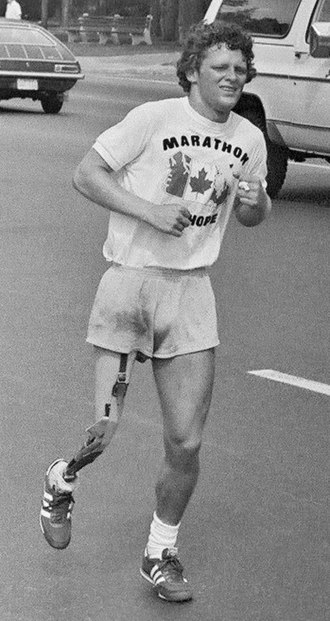
Terrance Stanley Fox was twenty-one years old, running on a custom fiberglass prosthesis, and battling a disease that had already claimed his right leg. On the morning of April 12, 1980, he dipped his artificial limb into the frigid waters of the Atlantic Ocean at St. John's, Newfoundland, signaling the commencement of a journey that would redefine the limits of human endurance and the heart of a nation. His objective was as simple as it was audacious: to run across the vast expanse of Canada on foot to raise money and awareness for cancer research. He called it the Marathon of Hope, a name that would soon echo in the hearts of millions of Canadians and people around the world. Terry's legacy is not just one of a tragic end, but of an indomitable will that continues to fund life-saving research decades after his final step.
Fox had been diagnosed with osteosarcoma, a rare and aggressive form of bone cancer, in March 1977. At only 18 years of age, he faced the traumatic reality of an amputation 15 centimeters above the knee. During his months of grueling recovery and chemotherapy, he witnessed the profound suffering of fellow cancer patients, particularly children, in the hospital wards. This experience forged a deep-seated resolve within him; he decided that if he survived, he would dedicate his life to changing the narrative of cancer. "I'm not a dreamer," he wrote in a historic letter to the Canadian Cancer Society. "And I'm not saying this will initiate any kind of definitive answer or cure to cancer. But I believe in miracles. I have to." This belief became the fuel for a mission that would cover 5,373 kilometres and raise over $24 million by the time of his death, ultimately generating over $1 billion for research in the years that followed.
The Early Life
Born on July 28, 1958, in Winnipeg, Manitoba, Terry was the second of four children to Rolland and Betty Fox. His father, a switchman for the Canadian National Railway, and his mother provided a stable, hard-working environment that emphasized persistence and integrity. In 1966, the family moved to Port Coquitlam, British Columbia, a place that would become Terry’s home and the site of his early athletic triumphs. From a young age, Terry was characterized by a relentless competitive streak and a refusal to give up, even when faced with superior opponents. He wasn't necessarily the most naturally gifted athlete, but he was undoubtedly the hardest worker.
In junior high school, Terry’s passion was basketball. Standing only five feet tall in grade eight, he was initially the least-played member of his team. His coach suggested he might be better suited for distance running or wrestling, but Terry was determined to make it in basketball. He spent his summers practicing on the outdoor courts until dusk, refining his shot and his stamina. By grade twelve, his tenacity had paid off; he was a starting guard and was named the school's Athlete of the Year alongside his best friend, Doug Alward. This same spirit followed him to Simon Fraser University, where he earned a spot on the junior varsity basketball team despite his stature and the increasing competition. His academic pursuits in kinesiology further deepened his understanding of the human body—knowledge that would later prove invaluable during the physical rigors of his cross-country run.
Terry’s diagnosis in 1977 was a pivot point that could have broken a lesser spirit. After the amputation, he was fitted with his first prosthetic leg and began the long process of learning to walk again. Characteristically, he didn't just want to walk; he wanted to compete. Within months, he was playing wheelchair basketball, leading his team to three national championships and being named an all-star by the North American Wheelchair Basketball Association. However, the memories of the cancer ward stayed with him. He recalled seeing young children, some only a few years old, facing the same terminal diagnosis he had narrowly escaped. It was this empathy, combined with his natural drive, that led him to conceive of the Marathon of Hope. He began training in secret, running over 5,000 kilometres in the dark of night around his neighborhood to prepare his body and his mind for the impossible task ahead.
The Hop and Skip Mechanics
Terry’s run was a mechanical feat as much as a physical one. He used a prosthesis designed by British Columbia prosthetist Ben Speicher. Known as the "Speicher Leg," it was a construct of fiberglass and steel weighing approximately 4 kilograms—double the weight of modern high-performance running blades.
The "hop and skip" gait that became Terry's trademark was born of mechanical necessity. The heavy steel springs in his artificial knee required extra time to reset after each step. To compensate for this "slow swing phase," Terry had to take two hops on his good leg for every one step on the prosthetic. Doctors predicted the gait would cause his joints to fail within weeks. Instead, he maintained it for 143 consecutive marathons.
The Marathon of Hope
The journey began with little fanfare in St. John's. Terry, accompanied by his friend Doug Alward, faced skepticism and indifference in the early days. He ran through the biting cold and fog of the Newfoundland spring, his gait a rhythmic thumping on the asphalt that became the soundtrack of his life. In those first few weeks, the Marathon of Hope was a lonely endeavor. They slept in a small van, ate cheap meals, and often struggled to find enough money for gas. Yet, Terry never missed a day. Even when his stump was blistered and bleeding, even when the wind was so strong it threatened to knock him over, he pressed on. He was running not just against the geography of Canada, but against the clock of his own mortality.
As he crossed into the Maritimes, the momentum began to shift. Word of the "one-legged runner" spread through local newspapers and radio stations. In Port aux Basques, the townspeople gathered to see him off, and the first significant donations began to trickle in. By the time he reached Nova Scotia and New Brunswick, the trickles had become a stream. Thousands of people began lining the highways, waving flags and cheering as the small Ford Econoline van passed by. Terry would stop to speak at community halls, schools, and shopping malls, his voice often hoarse but his message unwavering: "The answer is to try and help others." He was no longer just a runner; he was becoming a symbol of hope for a nation that had found its hero in the most unlikely of places.
The entry into Ontario marked the peak of the Marathon of Hope. In Ottawa, he met Prime Minister Pierre Trudeau and kicked the ceremonial opening ball at a CFL game. In Toronto, he was greeted by a crowd of over 10,000 people at Nathan Phillips Square, where he stood alongside hockey legend Darryl Sittler. The emotional weight of the run was becoming as heavy as the physical toll. Terry was now running 42 kilometres a day through the stifling heat of an Ontario summer, his body thin and his face etched with exhaustion. Yet, the support of the public energized him. He was raising millions of dollars, and more importantly, he was changing the way people talked about cancer. It was no longer a whispered death sentence; it was a challenge to be met with courage and collective action.
The Human Element
While the world saw a solitary runner, the Marathon of Hope was a team effort defined by grit and friction. His best friend, Doug Alward, drove the Ford Econoline van that served as their mobile base. Their relationship was the mission's backbone, though it was often strained to the breaking point by exhaustion. They shared a cramped space, limited resources, and the immense pressure of the growing public spotlight. By the time they reached Quebec, the mental fatigue was as debilitating as the physical pain, and they were barely on speaking terms. It was the arrival of Terry’s younger brother, Darrell, that provided the necessary bridge between them, allowing the mission to continue despite the personal toll.
The role of his family cannot be overstated. His mother, Betty Fox, was initially terrified of the run, fearing for her son's health. Yet, she became his fiercest advocate and the primary guardian of his legacy after his death. His father, Rolly, provided the quiet strength that Terry had inherited. The family's Métis heritage, which they only fully discovered and embraced in later years, added another layer to Terry's story—a connection to the land and a lineage of resilience that resonated deeply with Indigenous communities across Canada. Terry wasn't just running for himself; he was running for his family, his friends, and every Canadian who had ever felt the sting of loss.
It was Isadore Sharp, the founder of Four Seasons Hotels, who turned the quixotic run into a national movement. Sharp, who had lost his own son, Chris, to melanoma in 1978, recognized in Terry the same spirit he wished for his son. He pledged $10,000 and challenged 999 other corporations to do the same, effectively institutionalizing the fundraising efforts. When Terry was forced to stop near Thunder Bay on September 1, 1980, after 143 days and 5,373 kilometres, it was Sharp who sent the legendary telegram: "You started it. We will not rest until your dream to find a cure for cancer is realized." This promise laid the foundation for the annual Terry Fox Run, which has since grown into the largest one-day fundraiser for cancer research in the world.
The Legacy
Terry Fox’s impact on Canada and the global medical community is immeasurable. When he was forced to stop his run in 1980, he had raised $1.7 million. By the time he passed away in June 1981, that number had reached $24 million—one dollar for every Canadian at the time. Today, the Terry Fox Foundation has raised over $850 million for cancer research, but the financial legacy is only part of the story. Terry changed the way the world views physical disability and the potential of a single individual to effect massive social change. He proved that a disability does not define a person’s limits and that collective action can be ignited by a single, unwavering spark of determination.
His name is immortalized across the Canadian landscape. From the Terry Fox Lookout near Thunder Bay to the numerous schools, parks, and roads named in his honour, his presence is woven into the very fabric of the country. He is the youngest-ever Companion of the Order of Canada and has been featured on postage stamps and a commemorative one-dollar coin. In 2004, he was ranked as the second-greatest Canadian of all time by a nationwide CBC poll, finishing only behind Tommy Douglas. Yet, perhaps his greatest legacy is the annual Terry Fox Run. Every September, millions of people in over 60 countries lace up their running shoes to continue the marathon he started. It is a day of community, remembrance, and action that ensures his dream never dies.
The Terry Fox Research Institute (TFRI), established in 2007, represents the scientific fulfillment of his mission. By connecting researchers across the country through the Marathon of Hope Cancer Centres Network, the institute has accelerated the development of precision medicine and genomic sequencing. The goal is to provide every Canadian cancer patient with a personalized treatment plan based on their unique genetic profile. Terry once said, "Even if I don't finish, we need others to continue." In the labs and clinics funded by his legacy, thousands of scientists and doctors are doing exactly that, pushing the boundaries of what is possible in the fight against cancer.
Notable Quotes
"I just wish people would realize that anything’s possible if you try; dreams are made possible if you try."
— Terry Fox
"It occurs very rarely in the life of a nation that the courageous spirit of one person unites all people in the celebration of his life and in the mourning of his death."
— Pierre Trudeau, Former Prime Minister of Canada
"I'm not a dreamer, and I'm not saying this will initiate any kind of definitive answer or cure to cancer. But I believe in miracles. I have to."
— Terry Fox, in his letter to the Canadian Cancer Society
"Even if I don't finish, we need others to continue. It’s got to keep going without me."
— Terry Fox
Operational Timeline
Origin
Terrance Stanley Fox is born in Winnipeg, Manitoba. A natural athlete with a relentless competitive streak.
Westward Bound
The Fox family moves to Port Coquitlam, BC. Terry begins to excel in school sports, particularly basketball.
The Pivot
Diagnosed with osteosarcoma. Leg amputation follows. The hospital experience watching other children suffer sparks the mission.
Secret Training
Begins training for a cross-Canada run in secret, eventually covering over 5,000 km around his neighborhood to prepare his body.
Marathon of Hope
Commences run in St. John's on April 12. Maintains a marathon-a-day pace for 143 consecutive days, reaching as far as Thunder Bay.
National Recognition
Named a Companion of the Order of Canada and wins the Lou Marsh Trophy as Canada's top athlete of the year.
Final Farewell
Terry Fox passes away on June 28 at the age of 22. A nation mourns as flags across Canada are flown at half-mast.
The First Run
The first annual Terry Fox Run is held on September 13 at 760 sites across Canada, raising $3.5 million in a single day.
Greatest Hero
Voted Canada's greatest hero in a national survey by Maclean's magazine, reflecting his enduring cultural impact.
The Greatest Canadian
Ranked #2 in the CBC's "The Greatest Canadian" series, solidifying his status as a foundational figure in national identity.
Scientific Legacy
The Terry Fox Research Institute is established to coordinate and accelerate cancer research efforts across Canada.
Scientific Frontier
The Terry Fox Digital Health Innovation Fund launches a $25-million initiative for AI-driven cancer diagnostics.
The Research Frontier
In 2024 and 2025, the Terry Fox Research Institute (TFRI) transitioned from building data infrastructure to delivering direct clinical utility. The Marathon of Hope Cancer Centres Network (MOHCCN) officially crossed the halfway mark of its mission, surpassing 7,600 cases with full genomic sequencing. This dataset is now the largest of its kind in Canada, allowing researchers to identify rare genetic drivers of cancer that were previously invisible.
A major breakthrough occurred in early 2025 with the Health Canada approval of in-human clinical trials for Porphysome nanoparticles. These light-activated particles can detect, illuminate, and destroy cancer cells with unprecedented precision. Funded by the foundation, this technology represents the realization of Terry's dream: a future where treatment is as precise as it is effective.