Technical Portrait 028
Tommy Prince
An elite warrior who fought ferociously for a country that systematically denied him the very freedoms he bled to defend.
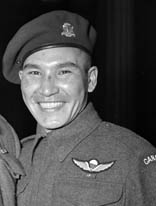
War relies on noise, chaos, and overwhelming force. Thomas George "Tommy" Prince operated entirely differently, moving with a silent precision that made him a ghost on the battlefield. An Ojibwe from the Brokenhead Reserve in Manitoba, his skills as a tracker and marksman were so exceptional that he routinely crossed deep into enemy lines undetected, operating with a lethal stealth that became legendary. His life was a remarkable journey of service, sacrifice, and a relentless pursuit of justice for his people, spanning two major conflicts and a lifelong battle against systemic inequality.
Early Life: The Spirit of a Warrior
Tommy Prince was born on October 25, 1915, in Petersfield, Manitoba, into a lineage of profound leadership and resilience. He was a great-grandson of the legendary Saulteaux Chief Peguis, who had led his people from Sault Ste. Marie to the Red River Valley and was a signatory to the first treaty in Western Canada. This heritage of stewardship and diplomacy was deeply ingrained in Prince from birth. Growing up on the Brokenhead Reserve, he was immersed in the traditional skills of the Ojibwe: tracking, hunting, and navigating the vast, often unforgiving Manitoba wilderness. By his teens, he was a crack shot with a rifle and possessed an uncanny ability to move through the bush without snapping a single twig.
However, the Canada of Prince's youth was one of profound restriction for Indigenous people. The residential school system and the Indian Act sought to erase the very culture that gave him his strength. Prince attended the Elkhorn Residential School, where he completed grade eight. Despite the systemic attempts to diminish his identity, his spirit remained unbroken. He took various laboring jobs, from woodcutting to farming, but when the shadows of World War II began to lengthen across Europe, he saw an opportunity not just to serve, but to prove the worth of his people on a global stage.
World War II: The Devil's Brigade
Prince's path into the military was initially blocked by the very racism he sought to transcend; he was rejected several times before finally being accepted into the Royal Canadian Engineers in June 1940. His talent, however, could not be suppressed. By 1942, he had volunteered for the parachute school and was selected for the 1st Canadian Parachute Battalion. His exceptional skills soon led to his recruitment into the First Special Service Force (FSSF)—a joint Canadian-American elite unit. The FSSF was designed for the most dangerous, high-stakes missions: sabotage, mountain warfare, and deep-reconnaissance. The Germans, who grew to fear their nighttime raids and blackened faces, dubbed them "The Devil's Brigade."
It was during the Italian Campaign that Prince performed his most famous act of daring. In February 1944, near Anzio, he was manning an observation post in an abandoned farmhouse just 200 meters from German lines. He was reporting enemy artillery positions via a 1,400-meter telephone wire when a shell severed the connection. Rather than retreating, Prince donned a tattered black shawl and civilian trousers over his uniform. He grabbed a hoe and walked out into the field, directly under the gaze of German snipers. For several minutes, he put on a masterful performance as a local farmer weeding his crops. When he reached the break in the wire, he knelt down, pretending to tie his shoe while expertly splicing the line. He then shook his fist at the German positions, then at the Allied lines, and calmly walked back to the house. He resumed his reports, leading to the destruction of four German batteries.
The Solo Reconnaissance
In the summer of 1944, during the invasion of Southern France, Prince once again displayed an almost superhuman level of endurance and skill. He was sent on a deep-reconnaissance mission to locate a German reserve battalion. Prince trekked 70 kilometers across rugged, mountainous terrain, operating without food, water, or sleep for 72 hours. He successfully located the enemy encampment, returned to his lines, and led his unit back to the site. The resulting assault led to the capture of over 1,000 German soldiers. For his actions in Italy and France, Prince was awarded the Military Medal (UK) and the Silver Star (USA). He was one of only three Canadians to receive both honors during the war, and he remains the most decorated Indigenous soldier in the nation's history.
The Korean War: A Second Call
Returning to Canada in 1945, Prince expected a hero's welcome. Instead, he found a country that still treated him as a second-class citizen. He was denied the right to vote in federal elections and was barred from the very Legions where his comrades gathered. Despite these insults, when the Korean War broke out in 1950, Prince re-enlisted with the 2nd Battalion, Princess Patricia’s Canadian Light Infantry (2 PPCLI). He famously told his friends that he felt he "owed something to his friends who died" in the previous war.
Despite being in his mid-30s and suffering from severe arthritis in his knees—the legacy of years of paratrooping and mountain warfare—Prince served with distinction. During the Battle of Kapyong in April 1951, his unit held a vital hilltop against waves of Chinese forces, a defense so fierce that the 2 PPCLI became the first Canadian unit to receive the United States Presidential Unit Citation. Prince served two tours in Korea, but the physical and psychological toll finally forced his discharge in 1954.
The Final Battle: Advocacy and Hardship
The latter half of Prince's life was a tragic struggle against the "invisible" enemies of trauma and systemic neglect. He became a prominent voice for Indigenous rights, serving as vice-president of the Manitoba Indian Association. He testified before a Special Joint Committee in Ottawa, calling for the total abolition of the Indian Act and for the government to respect traditional treaties. He argued passionately that if Indigenous men could die for Canada, they should be allowed to live as equals within it.
However, the weight of his experiences—what we now recognize as PTSD—coupled with the heartbreak of seeing his people continue to suffer, led Prince into a downward spiral. He struggled with alcoholism and poverty, eventually selling his medals to make ends meet. He spent his final years living in a Salvation Army hostel in Winnipeg. When he passed away on November 25, 1977, he was 62 years old. His funeral was a rare moment of national recognition, attended by hundreds of veterans and dignitaries, as Saulteaux warriors sang the "Death of a Warrior" song to honor a man who had given everything for a country that gave him so little.
Legacy: A National Treasure
Today, Tommy Prince's legacy is finally being given the weight it deserves. He has been designated a National Historic Person, and his face appeared on a commemorative Canada Post stamp in 2022. Numerous schools, barracks, and streets across the country bear his name, serving as a permanent reminder of his elite skill and moral courage. More importantly, he remains a symbol of the profound contributions and the enduring resilience of Indigenous veterans. Tommy Prince's story is no longer a footnote; it is a central pillar of the Canadian narrative, a testament to a man who was a phantom in war and a lion in the fight for justice.
Notable Quotes
"All my life I had wanted to do something to help my people recover their good name. I wanted to show they were as good as any white man."
"The killing that comes out of a war destroys a part of a man that cannot be explained."
"I re-enlisted because I felt I owed something to my friends who died in the last war. We fought for freedom together, and that bond doesn't break."
Operational Timeline
Birth
Born in Petersfield, Manitoba, descendant of Chief Peguis.
Enlistment
Enlists in the Royal Canadian Engineers after multiple attempts.
Paratrooper Training
Volunteers for the 1st Canadian Parachute Battalion and joins the elite First Special Service Force (FSSF).
The Anzio "Farmer"
Repairs a communication wire behind enemy lines disguised as a farmer, directing fire on German batteries.
France Reconnaissance
Trekks 70km in 72 hours solo to locate German reserves, leading to 1,000 captures.
Decorations
Receives the Military Medal and Silver Star from King George VI at Buckingham Palace.
Indigenous Advocacy
Becomes Vice-President of the Manitoba Indian Association, fighting for the abolition of the Indian Act.
Korean War Re-enlistment
Joins the 2nd Battalion, PPCLI to serve in the Korean War.
Battle of Kapyong
Plays a key role in the defense of Kapyong; his unit receives the U.S. Presidential Unit Citation.
Honourable Discharge
Discharged due to medical reasons, primarily chronic arthritis in his knees.
Passing
Dies in Winnipeg. His funeral is attended by 500 mourners including military and government leaders.
National Recognition
Designated a National Historic Person by the Government of Canada.
Commemorative Stamp
Canada Post releases a stamp in his honour during National Indigenous History Month.